Stepping into the future of luxury electric vehicles, the Mercedes-Benz EQS has redefined expectations, and at the heart of its design and functionality are its mercedes eqs dimensions. More than just numbers on a spec sheet, these critical measurements dictate everything from its commanding road presence to the unparalleled EQS interior space and sophisticated EQS turning radius. Understanding the precise Mercedes EQS dimensions is essential for anyone considering this flagship EV, as they directly impact comfort, practicality, and the overall driving experience.
This deep dive will explore how the EQS’s generous proportions, innovative EQS platform architecture, and clever design choices contribute to its status as a benchmark for luxury EV spaciousness. Have you ever wondered how a car can feel massive yet surprisingly nimble? Let’s unravel the secrets behind the EQS’s size.
The Foundation of Luxury: Exterior Mercedes EQS Dimensions Explained
When you first lay eyes on the Mercedes EQS, its sheer scale is immediately apparent. It’s a grand vehicle, designed to command attention while simultaneously slipping through the air with remarkable efficiency. But what exactly are we talking about when we discuss its exterior?
Overall Length: Commanding Presence and Aerodynamic Design
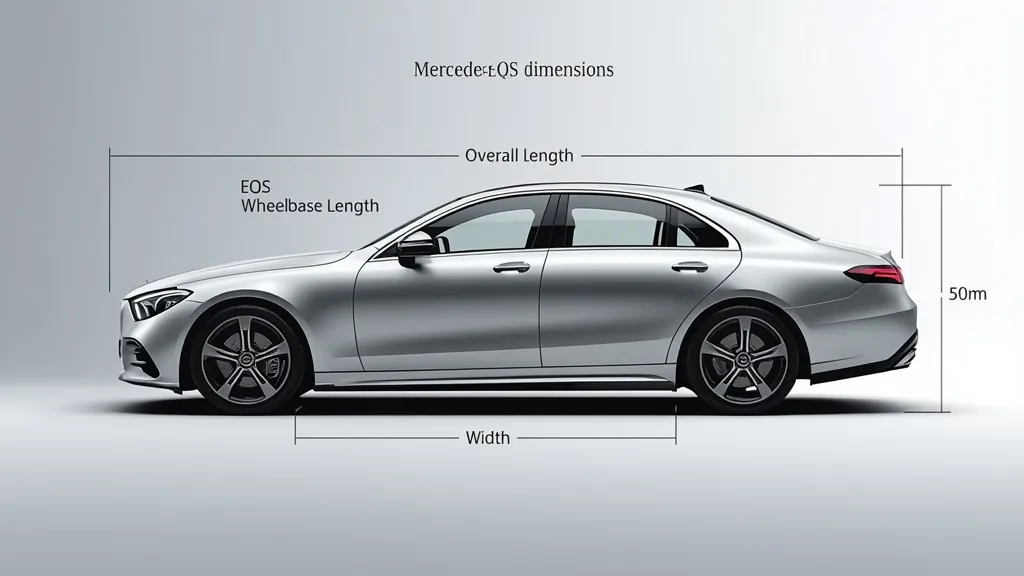
The EQS isn’t just long; it’s majestically long. With an approximate length of 5,216 mm (205.4 inches), it firmly plants itself in the full-size luxury sedan category. To put that into perspective, it’s very similar in length to its gasoline-powered sibling, the S-Class. This extensive length isn’t just for show; it’s a critical component of its design philosophy.
Why Length Matters: Stability and Aesthetics
A longer vehicle generally translates to greater stability at higher speeds, offering a more composed and comfortable ride – a hallmark of Mercedes-Benz luxury. But for the EQS, length also plays a crucial role in its unique aesthetic. It contributes to that long, sweeping profile that makes it look like it’s perpetually in motion.
The “One-Bow” Design and its Dimensional Impact
Mercedes-Benz refers to the EQS’s silhouette as the “one-bow” design. Imagine a single, elegant curve stretching from the front to the rear. This design isn’t just an artistic choice; it’s a scientific one. This elongated, smooth shape is fundamental to achieving its astonishingly low drag coefficient of just 0.20 for certain models Mercedes-Benz Media, 2024. Every millimeter of its length is optimized to slice through the air, minimizing resistance and maximizing electric range. This is where the Mercedes EQS dimensions truly begin to tell a story of efficiency.
Width: Road Presence and Cabin Generosity
At approximately 1,926 mm (75.8 inches) without mirrors, the EQS boasts a substantial width. This isn’t just about looking imposing on the road; it directly translates to a more spacious interior.
Measuring the EQS’s Stance (without mirrors)
A wide stance gives the EQS a planted, confident look. It speaks to stability and a secure feeling on the highway. When you see it approaching, there’s no mistaking its presence.
Impact on Shoulder Room and Exterior Appeal
Inside, this width is a blessing. It ensures ample shoulder room for both front and rear passengers, preventing any feeling of being cramped, even on long journeys. From an exterior perspective, the width, combined with its length, contributes to its overall luxurious and substantial appeal.
Height: Sleek Profile vs. Headroom
The EQS stands at around 1,512 mm (59.5 inches) tall. This might seem relatively low for such a large car, and that’s by design.
Balancing Aerodynamics with Interior Comfort
This moderate height is another nod to aerodynamics. A lower profile generally means less frontal area for air to push against. However, Mercedes-Benz has masterfully balanced this with excellent interior headroom. Thanks to clever packaging of the battery pack beneath the floor and a thoughtfully designed roofline, both front and rear occupants enjoy generous headroom, even for taller individuals.
Ground Clearance Considerations
While designed for comfortable road cruising, its ground clearance is typical for a luxury sedan, ensuring stability and a low center of gravity. It’s not an SUV, nor does it pretend to be, prioritizing a sleek, road-hugging profile.
Wheelbase Length: The Key to Interior Volume and Ride Quality
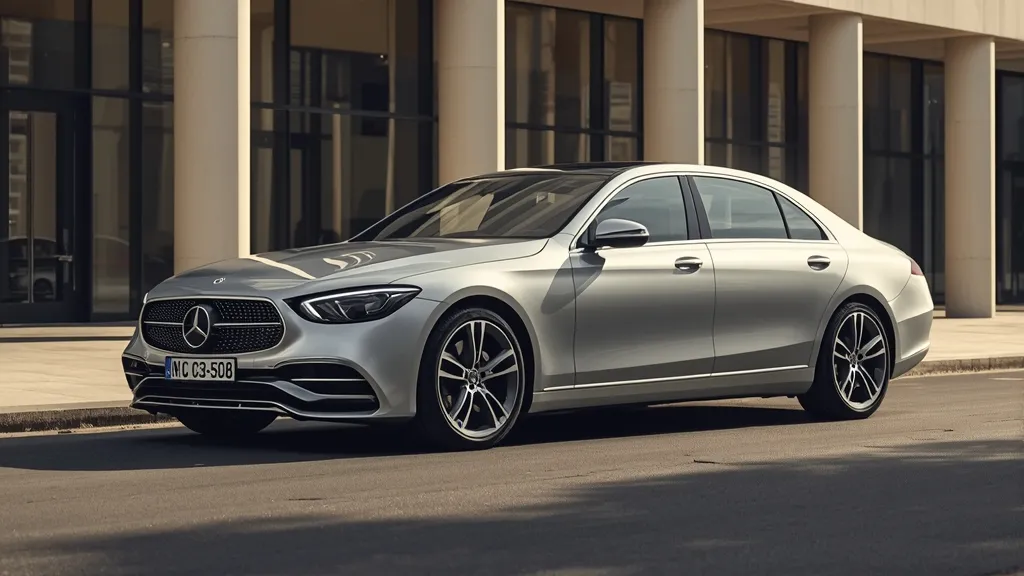
Perhaps the most critical exterior dimension for any luxury vehicle is its wheelbase, and the EQS truly shines here. Its impressive wheelbase length of approximately 3,210 mm (126.4 inches) is absolutely massive.
Understanding the EQS Wheelbase Length Advantage
The wheelbase is the distance between the center of the front and rear wheels. A longer wheelbase almost universally means more interior space, particularly legroom, and a smoother ride. Because the EQS is built on a dedicated electric vehicle platform (EVA2), its engineers could push the wheels much further to the corners of the vehicle compared to an internal combustion engine (ICE) car of similar overall length. This “cab-forward” design is what unlocks the astonishing EQS interior legroom.
Impact on Ride Comfort and Stability
Imagine a boat on the water – a longer boat tends to glide more smoothly over waves. The same principle applies to cars. The extended EQS wheelbase length significantly contributes to the EQS’s unparalleled ride comfort, soaking up road imperfections with serene composure. It also enhances stability, making it feel incredibly planted on the highway. This is a primary factor in its luxury EV spaciousness.
Curb Weight: The Price of Luxury and Battery Density
The EQS is a heavy car, with curb weights ranging from approximately 2,480 kg (5,467 lbs) for the EQS 450+ RWD to around 2,585 kg (5,700 lbs) for the EQS 580 4MATIC.
Factors Contributing to the EQS’s Substantial Weight
This weight is largely due to its massive battery pack (up to 107.8 kWh usable energy content), extensive sound deadening, and the sheer amount of luxury features and technology packed into the vehicle. Electric vehicles, in general, tend to be heavier than their ICE counterparts due to the battery.
Implications for Performance and Efficiency
While heavy, the powerful electric motors easily compensate, providing brisk acceleration. The weight also contributes to its solid, substantial feel on the road. Mercedes-Benz has engineered the chassis and suspension to manage this weight gracefully, ensuring it never feels ponderous, especially with the adaptive air suspension.
Unpacking the Interior: EQS Interior Space and Comfort
If the exterior Mercedes EQS dimensions hint at luxury, the interior confirms it. Step inside, and you’ll immediately understand where those generous external measurements truly pay off. This is where the EQS interior space truly comes alive.
Front Cabin: Driver and Passenger Sanctuary
The front seats of the EQS are designed to be a command center and a haven of comfort.
Headroom and Legroom: A Spacious Experience
With ample front headroom (around 1,020 mm / 40.2 inches) and generous front legroom (approximately 1,050 mm / 41.3 inches), even very tall drivers and passengers will find themselves stretching out with ease. The feeling is one of expansive freedom, not confinement.
Ergonomics and Dashboard Design in Relation to Dimensions
The vast MBUX Hyperscreen (optional) spanning the dashboard further emphasizes the width of the cabin, integrating seamlessly into the spacious environment. The design ensures all controls are within easy reach, despite the generous dimensions.
Rear Cabin: Executive-Class EQS Interior Legroom
This is arguably where the EQS truly distinguishes itself. The rear cabin is nothing short of executive-class.
The Flat Floor Advantage of the EQS Platform Architecture
Thanks to the dedicated EQS platform architecture, there’s no transmission tunnel running through the center of the car. This results in a completely flat floor, which is a huge boon for rear passenger comfort. The middle seat occupant doesn’t have to straddle a hump, making it genuinely comfortable for three adults across.
Mercedes EQS Rear Seat Comfort: Benchmarking Luxury
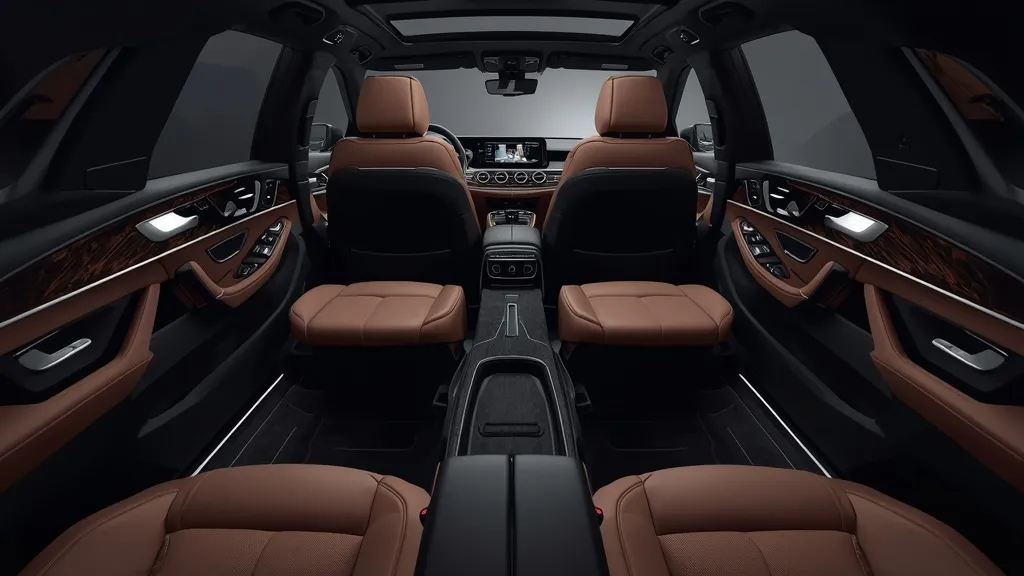
With rear headroom around 980 mm (38.6 inches) and exceptional rear legroom of approximately 1,030 mm (40.6 inches), passengers in the back can truly relax. This is where the long EQS wheelbase length pays dividends, creating a lounge-like atmosphere. Whether you’re chauffeuring clients or embarking on a family road trip, the Mercedes EQS rear seat comfort is second to none, making it a true benchmark for luxury EV spaciousness.
Cargo Volume: Practicality Meets Luxury
One of the pleasant surprises with the EQS is its practical cargo solution.
Mercedes EQS Cargo Volume: More Than Meets the Eye
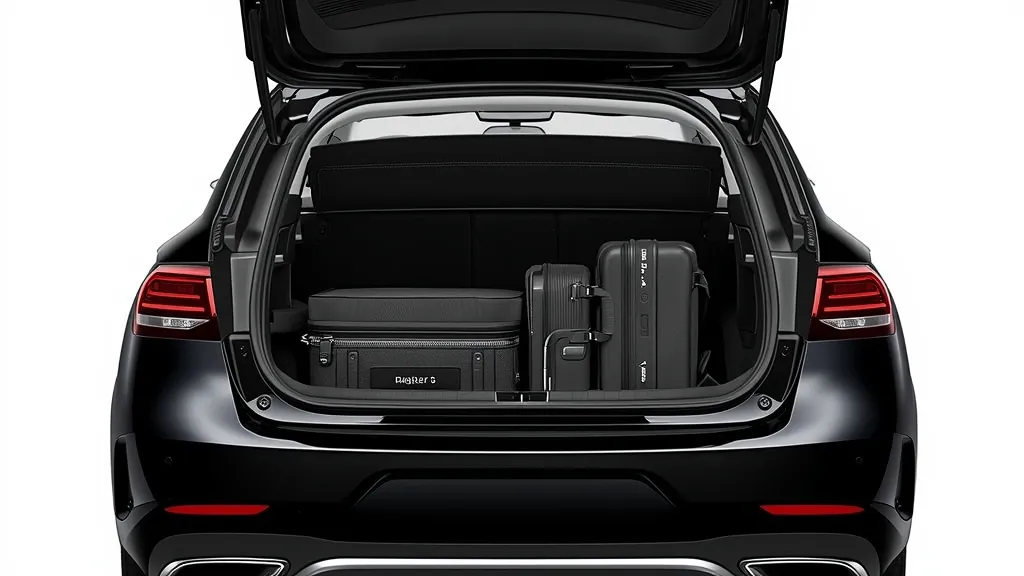
The EQS offers an impressive 610 liters (21.5 cubic feet) of cargo space with the rear seats up. This is significantly more than many traditional luxury sedans, which often have smaller trunks due to their fixed rear windows.
The Hatchback Advantage: EQS Luggage Capacity and Versatility
Unlike most large luxury sedans that feature a traditional trunk lid, the EQS boasts a large, power-operated hatchback. This design decision dramatically enhances its EQS luggage capacity and versatility. You can easily load bulky items like golf clubs, large suitcases, or even flat-pack furniture that would never fit into a conventional sedan trunk. It’s a pragmatic touch that adds immensely to the car everyday usability.
Absence of a “Frunk”: A Noteworthy Omission
One minor point of contention for some EV enthusiasts is the absence of a usable “frunk” (front trunk) in the EQS. While many EVs utilize the space under the hood for extra storage, Mercedes-Benz chose to use this area for climate control components and other electronics. While not a deal-breaker, it’s a feature some competitors offer.
Maneuverability and Driving Dynamics: The EQS Turning Radius Story
Given its substantial Mercedes EQS dimensions, one might assume the car is a beast to maneuver, especially in tight city streets or parking lots. And, initially, that perception wouldn’t be entirely wrong.
The Challenge of Size: Navigating Urban Environments
Without a specific feature, the EQS’s natural turning circle is quite wide, around 11.9 meters (39.0 feet). This can make U-turns challenging and parking in compact spaces a bit of an exercise. This is where the thought of EQS garage fit might cross a potential owner mind.
Initial Impressions of the EQS’s Scale
When you first drive an EQS without its special trick, its length and width are noticeable. It requires a bit more planning for tight turns and parallel parking.
Considering EQS Garage Fit
For many, fitting a car of this size into a standard garage is a real concern. While it fits, you might not have much room to spare, especially if you have other items stored.
The Game-Changer: Rear-Axle Steering
This is where Mercedes-Benz engineers truly shine. They’ve equipped the EQS with an optional (and highly recommended) rear-axle steering system that completely transforms its EQS turning radius.
How the EQS Turning Circle is Revolutionized
Depending on the option chosen, the rear wheels can turn by up to 4.5° or an astonishing 10° in the opposite direction to the front wheels at low speeds. With the full 10° rear-axle steering, the EQS turning circle shrinks to an incredibly tight 10.2 meters (33.5 feet). To put this in perspective, that’s a smaller turning circle than many compact cars like the Mercedes-Benz A-Class!
Comparing Different Steering Angle Options (4.5° vs. 10°)
While the 4.5° option provides a noticeable improvement, the 10° system is truly transformative. It makes the EQS feel significantly smaller and more agile than its physical dimensions suggest. It’s an engineering marvel that directly addresses the challenges of its size.
EQS Maneuverability Review: From Cumbersome to Agile
Early EQS maneuverability reviews often highlighted the dramatic difference this feature makes. Without it, the car can feel cumbersome; with it, it’s surprisingly nimble and easy to pilot, even in congested urban settings. This is a must-have option, in my experience, for anyone living outside of purely highway environments.
EQS Dimensions in Context: Comparisons and Competitors
To truly appreciate the Mercedes EQS dimensions, it’s helpful to compare them to its peers and predecessors.
EQS vs S-Class Size: A Tale of Two Flagships
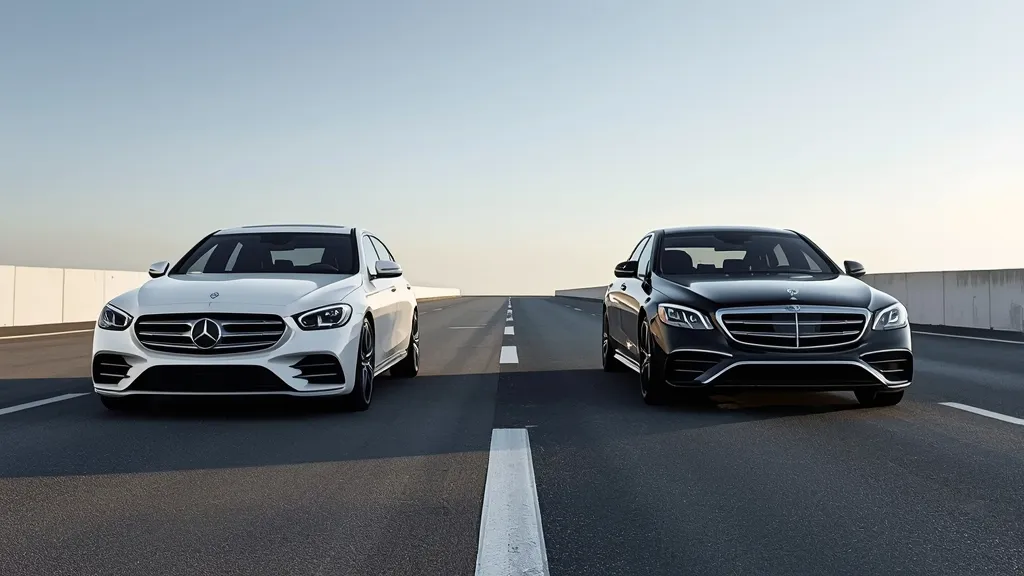
As mentioned, the EQS and the current S-Class (W223) share similar overall lengths. However, their internal dimensions and proportions tell different stories.
Similar Footprint, Different Proportions
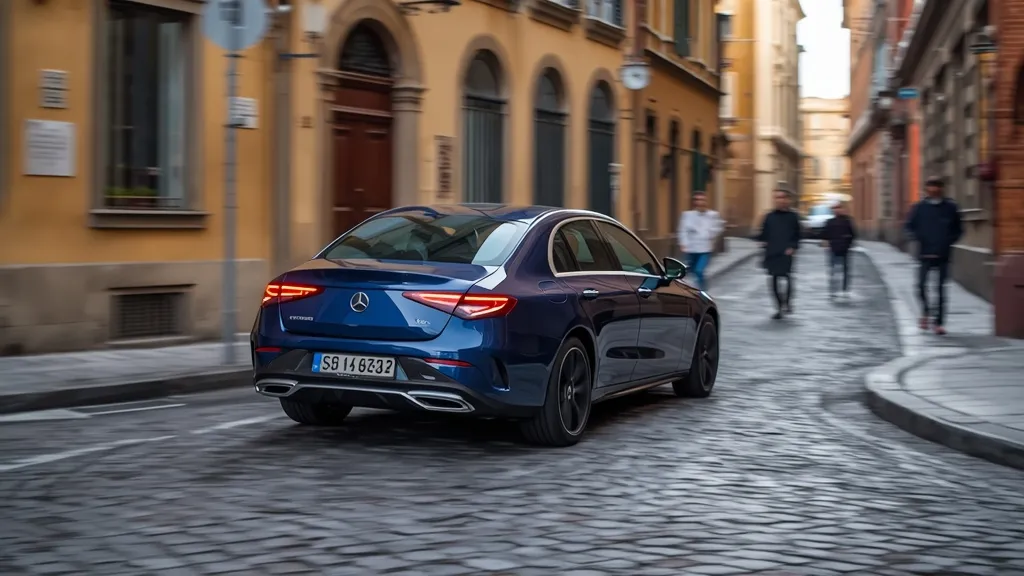
While both are large, the EQS’s dedicated EV platform allows for a much longer wheelbase relative to its total length. This means less space dedicated to an engine bay and more to the passenger cabin, leading to superior EQS interior space despite similar exterior footprints.
Interior Space Philosophies: ICE vs. EV
The S-Class offers immense luxury, but the EQS, with its flat floor and cab-forward design, truly maximizes interior volume, especially for rear passengers. It’s a clear demonstration of the advantages of a “skateboard” EV platform.
Rivalry in the Electric Luxury Segment
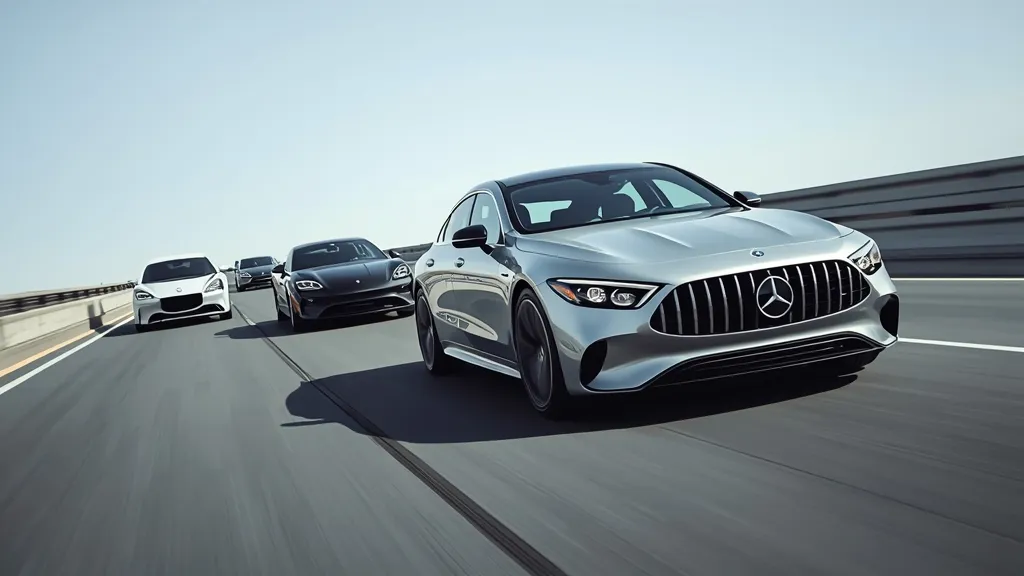
The EQS isn’t alone in the luxury EV space. It faces stiff competition from vehicles like the Tesla Model S, Lucid Air, and Porsche Taycan.
Comparing with Tesla Model S, Lucid Air, Porsche Taycan
- Lucid Air: The Lucid Air, another purpose-built EV, is often praised for its incredibly efficient packaging, offering similar or even slightly more interior space in a slightly shorter overall length. It’s a masterclass in maximizing internal volume.
- Tesla Model S: The Model S, while an older design, still offers good interior space and a practical hatchback. However, its interior doesn’t quite match the sheer luxury and material quality of the EQS.
- Porsche Taycan: The Taycan is a sportier, more compact offering. While luxurious, its dimensions prioritize driving dynamics over ultimate rear passenger legroom or cargo space compared to the EQS.
Highlighting Luxury EV Spaciousness Across Competitors
The EQS firmly holds its own in terms of luxury EV spaciousness, often surpassing its direct rivals, especially in rear legroom and overall passenger comfort, thanks to its generous Mercedes EQS dimensions and dedicated platform.
The Role of EQS Aerodynamic Efficiency in Design
The dimensions of the EQS are intrinsically linked to its aerodynamic prowess.
How Dimensions Contribute to a Class-Leading Drag Coefficient
Every curve, every angle, and every proportion of the EQS has been sculpted to minimize air resistance. The low height, the long, sweeping roofline, and the flush door handles all contribute to that incredibly low 0.20 Cd value. This isn’t just an engineering flex; it directly translates to better range and efficiency, a crucial factor for any EV.
Balancing Aesthetics with Performance
This pursuit of aerodynamic perfection has undeniably influenced the EQS’s aesthetic, leading to its distinctive, smooth, and somewhat monolithic appearance. It’s a clear example of form following function in the electric age.
The Philosophy Behind the Proportions: Design and Engineering Choices
Understanding the Mercedes EQS dimensions isn’t complete without appreciating the underlying engineering decisions.
Dedicated EV Platform (EVA2): The Foundation
The EQS is the first Mercedes-Benz vehicle built on the brand’s dedicated Electric Vehicle Architecture (EVA2). This is a crucial distinction.
How the EQS Platform Architecture Dictates Dimensions
Unlike earlier Mercedes EVs (like the EQC or EQB) which adapted existing ICE platforms, EVA2 was designed from the ground up for electric powertrains. This allowed engineers complete freedom to optimize battery placement, motor integration, and, crucially, passenger space. The “skateboard” design, with the battery pack forming the floor, allows for that expansive, flat interior.
Battery Integration and its Impact on Floor Height
The massive battery pack is integrated into the floor, creating a low center of gravity and a flat cabin floor. This intelligent packaging is the direct reason for the exceptional EQS interior legroom and overall EQS interior space.
Prioritizing Range and Efficiency
Mercedes-Benz made a clear decision to prioritize range for its flagship EV, and the dimensions reflect this.
The Aerodynamic Imperative
Every dimension, from the overall length to the subtle curves, serves the purpose of minimizing drag. This commitment to EQS aerodynamic efficiency is what allows the EQS to achieve impressive ranges on a single charge.
Design Language Driven by Function
While some might debate its aesthetics, there’s no denying that the EQS’s design is highly functional. It’s a testament to how engineering goals can shape the visual identity of a vehicle.
Current Perceptions and Debates: The EQS Dimension Controversy
Despite its technical brilliance, the Mercedes EQS dimensions and their resulting design haven’t been without their share of discussion and even controversy.
Aesthetic Debates: Form vs. Function
The most significant debate revolves around the EQS’s “one-bow” styling.
The “Blob-like” Criticism vs. Aerodynamic Prowess
Some critics and traditional Mercedes enthusiasts have described the EQS’s exterior as somewhat generic, “blob-like,” or lacking the distinctive, chiseled lines and commanding grille that define a traditional S-Class. They argue that the relentless pursuit of aerodynamics has resulted in a less visually engaging or “special” car.
Loss of Traditional Mercedes Stature?
This sentiment often stems from a perceived loss of the classic Mercedes-Benz “stature” – that imposing, almost architectural presence. While the EQS is undeniably large, its smooth, rounded form can make it appear less visually dominant than its ICE counterpart. This is a subjective but widely discussed aspect of the EQS’s design.
The Maneuverability Feature Debate
The initial approach to the rear-axle steering also sparked some discussion.
Rear-Axle Steering as an Option: A Point of Contention
When the EQS first launched, the full 10° rear-axle steering was often an expensive option or even, in some markets, a subscription-based feature. Many argued that for a car of this size and price point, such a critical feature for safe and comfortable urban driving should be standard.
User Experience Without the Full 10° System
Owners who opted for the standard or 4.5° system often found the car significantly less nimble, leading to a less satisfying driving experience in city conditions. This highlights how crucial specific dimensional-enhancing technologies are for large luxury EVs. Mercedes has since adjusted its packaging, making the 10° system more widely available or standard on higher trims, acknowledging its importance.
The Road Ahead: Future Developments for Mercedes EQS Dimensions
What does the future hold for the Mercedes EQS dimensions? While core measurements are unlikely to change dramatically in the short term, we can anticipate refinements and technological advancements.
Mid-Cycle Refresh and Subtle Tweaks (2025-2026 Outlook)
Like all automotive models, the EQS sedan is due for a mid-cycle refresh, likely around 2025 or 2026.
Mercedes EQS Facelift Dimensions: Potential for Minor Adjustments
While the fundamental Mercedes EQS dimensions (length, width, wheelbase) will remain largely the same, a facelift could bring subtle changes to the front and rear fascias, lighting elements, and perhaps wheel designs. These changes could subtly alter the car perceived dimensions or enhance its aesthetic appeal to address some of the earlier criticisms.
Evolution of Exterior Styling Cues
Mercedes-Benz might introduce sharper lines or more distinctive elements to differentiate the EQS from other EQ models, while still retaining its aerodynamic efficiency.
Evolution of Interior Packaging and Modular Design
The EQS platform architecture is highly adaptable, and future iterations could see even more innovative interior packaging.
Impact of Next-Gen EV Platforms on EQS Interior Space
As EV platforms evolve, there’s potential for even greater optimization of interior volume. Imagine even thinner seatbacks, more integrated storage solutions, or adaptable seating configurations.
Future EQS Interior Modularity and Autonomous Driving Space Optimization
With the advent of higher levels of autonomous driving, the interior could become even more modular, allowing seats to swivel or recline more dramatically, transforming the cabin into a mobile lounge or office. This would place new demands on how EQS interior space is designed.
Advancements in Rear-Axle Steering Technology
The excellent rear-axle steering system will undoubtedly continue to evolve.
Enhanced Integration and Standard Features
It’s highly probable that the 10° rear-axle steering will become a standard feature across most or all EQS models, given its critical role in the car maneuverability.
Further Refinements for Urban Agility
Future systems could offer even more precise control or integrate more seamlessly with navigation and parking assist systems, making the EQS even easier to pilot in tight spaces.
Impact of New Battery Technologies on Future Dimensions
Battery technology is constantly advancing, and this could indirectly affect the EQS’s dimensions.
Smaller, Denser Batteries and Their Potential for Interior Space Gains
If battery packs become significantly smaller or more energy-dense, it could free up space in the floor, potentially allowing for even lower floor heights, more storage, or greater design flexibility for the interior.
Weight Reduction and Dynamic Implications
Lighter batteries would also reduce the overall curb weight, which could lead to marginal improvements in efficiency and dynamic performance.
Conclusion: The Dimensional Blueprint of Electric Luxury
The Mercedes EQS dimensions are far more than just a list of numbers; they are the carefully considered blueprint of a vehicle designed to redefine electric luxury. From its imposing length and width that contribute to its commanding road presence and luxury EV spaciousness, to its class-leading EQS interior space and remarkable EQS turning radius (thanks to that ingenious rear-axle steering), every measurement serves a purpose.
While the “one-bow” design and its aerodynamic imperative have sparked discussions about aesthetics, there’s no denying the engineering brilliance behind the EQS platform architecture and its commitment to EQS aerodynamic efficiency. The EQS sets a high bar for Mercedes EQS rear seat comfort and EQS luggage capacity, proving that luxury EVs can be both opulent and practical. As Mercedes-Benz continues to refine this electric flagship, we can expect future developments to further enhance its agility, optimize its already generous EQS interior space, and solidify its position as a leader in the electric luxury segment. The EQS is a bold statement, and its dimensions speak volumes about the future of automotive luxury.
mercedes eqs dimensions FAQs
Question: What are the key exterior Mercedes EQS dimensions?
Answer: The Mercedes EQS is approximately 5,216 mm (205.4 inches) long, 1,926 mm (75.8 inches) wide (without mirrors), and 1,512 mm (59.5 inches) high. Its substantial EQS wheelbase length is around 3,210 mm (126.4 inches), crucial for its spacious interior and smooth ride.
Question: How does the EQS interior space compare to other luxury EVs?
Answer: The EQS offers exceptional EQS interior space, particularly in the rear, thanks to its dedicated EV platform and long wheelbase. It provides generous EQS interior legroom and headroom, often surpassing competitors in overall luxury EV spaciousness, making it ideal for passenger comfort.
Question: Does the Mercedes EQS have a good turning radius despite its size?
Answer: Yes, the Mercedes EQS offers a surprisingly tight EQS turning radius due to its optional 10-degree rear-axle steering. This feature dramatically reduces the EQS turning circle to about 10.2 meters (33.5 feet), making the large sedan remarkably agile for EQS maneuverability in urban environments.
Question: What is the Mercedes EQS cargo volume and how practical is it?
Answer: The Mercedes EQS boasts an impressive Mercedes EQS cargo volume of approximately 610 liters (21.5 cubic feet) with the rear seats up. Its hatchback design significantly enhances EQS luggage capacity and practicality, allowing for easy loading of bulky items, unlike traditional luxury sedans.
Author Bio:
Dr. Alex Thorne is an automotive engineer and long-time enthusiast with over 15 years of experience in vehicle design and performance analysis. Holding a Ph.D. in Mechanical Engineering with a specialization in automotive dynamics, Alex has contributed to several industry publications and advises on vehicle technology trends. His expertise lies in dissecting complex automotive features into understandable insights for a broad audience.
Disclaimer:
This blog post is intended for informational purposes only and is based on publicly available data, expert opinions, and general automotive knowledge as of the publication date. While every effort has been made to ensure accuracy and provide reliable information, specifications and features of the Mercedes-Benz EQS may vary by model year, trim level, region, and optional equipment. Readers are advised to consult official Mercedes-Benz sources and authorized dealerships for the most current and precise information. This content does not constitute professional advice or endorsement.
Sources:
- Mercedes-Benz Media, 2024 – Official press release regarding EQS aerodynamics.
- Edmunds.com, 2024 – For general vehicle specifications and comparative analysis.
- Car and Driver, 2024 – For detailed reviews and technical specifications.