
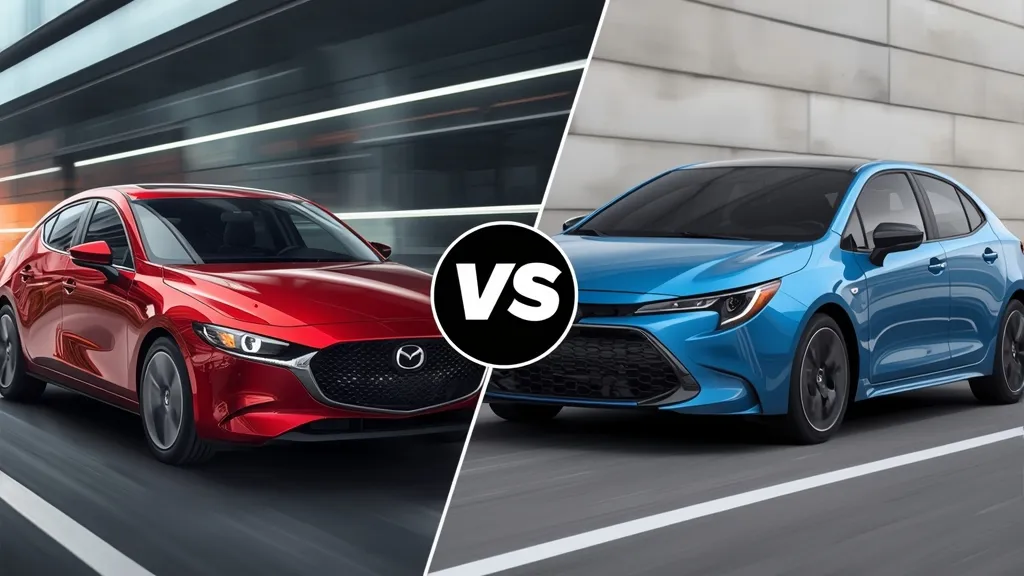
Choosing between the Mazda 3 vs Toyota Corolla is a rite of passage for many car buyers. It is the classic automotive dilemma: do you follow your heart or your head? For decades, these two Japanese titans have dominated the compact segment, but they offer vastly different experiences. Whether you are looking for a driver-focused compact car that feels like an entry-level luxury compact or a sensible, fuel-efficient compact car options that will likely outlast your mortgage, this comparison is for you. In this deep dive, we will explore the Mazda 3 vs Corolla reliability comparison, their distinct Mazda 3 vs Toyota Corolla driving dynamics, and which one ultimately earns the title of the best small car for commuters.
A Legacy of Excellence: Historical Perspective
To understand the current Mazda 3 vs Toyota Corolla rivalry, we have to look at where they came from. The Toyota Corolla is a global phenomenon. Since its introduction in 1966, it has become the best-selling nameplate in history. Its legacy is built on a simple promise: it will start every morning, and it will get you where you need to go with minimal fuss.
On the other hand, the Mazda 3 arrived much later, in 2004, replacing the beloved but aging Protegé. From day one, Mazda’s mission was different. They didn’t just want to provide transportation; they wanted to provide “Zoom-Zoom.” While the Corolla focused on the masses, the Mazda 3 targeted the enthusiast on a budget. Over four generations, the Mazda 3 has evolved from a sporty economy car into something much more sophisticated, challenging European luxury brands in terms of design and material quality.
Design and Aesthetics: Form Meets Function
When you pull into your driveway, which car do you want to see waiting for you? Aesthetics are subjective, but the design philosophies here couldn’t be further apart.
Exterior Styling: Kodo vs. Keen Look
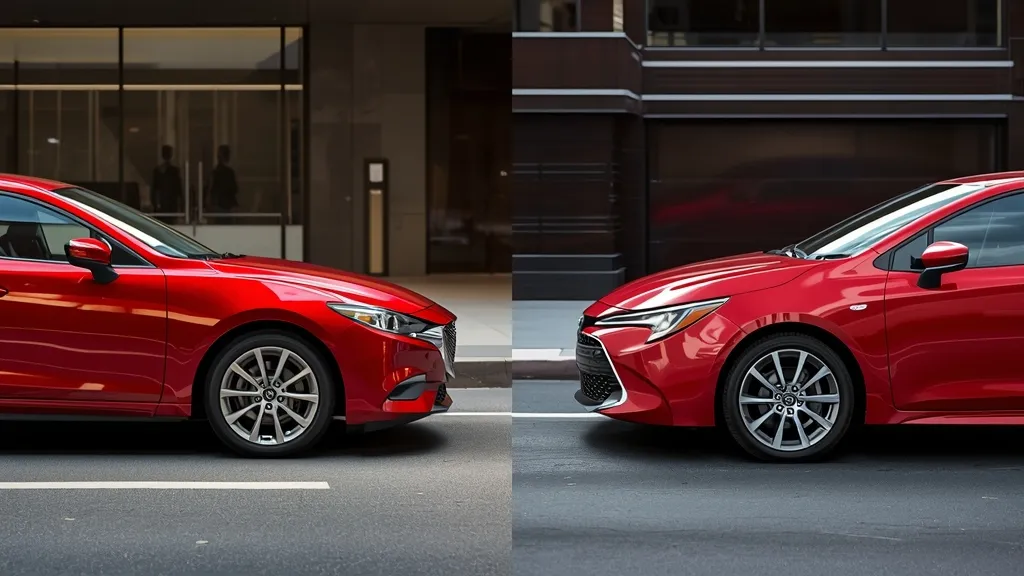
Mazda utilizes its “Kodo: Soul of Motion” design language. The result is a car with flowing lines, minimal creases, and a sense of movement even when standing still. The Mazda 3, especially in its signature Soul Red Crystal Metallic, looks significantly more expensive than its price tag suggests.
The Toyota Corolla, particularly in its latest generation, has shed its “appliance” image. With its “Keen Look” styling, it features sharp angles, a wide stance, and aggressive LED lighting. While the Mazda looks elegant and organic, the Corolla looks tech-forward and sporty, especially in the SE or XSE trims.
Interior Design Philosophy: Premium vs. Practical
Step inside, and the Mazda 3 vs Corolla interior quality debate becomes very clear.
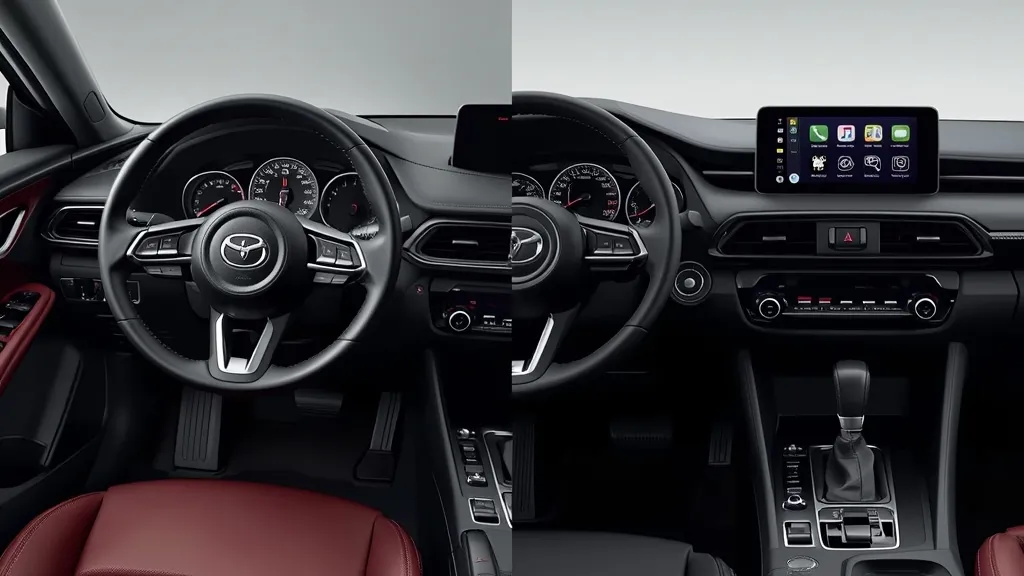
The Mazda 3 feels like an entry-level luxury compact. The dashboard is minimalist, wrapped in soft-touch materials with real stitching. Every knob and button has a weighted, tactile feel that you would expect from an Audi or a BMW. It is a cockpit designed around the driver.
The Toyota Corolla interior is the definition of “user-friendly.” It doesn’t try to be a luxury car; instead, it focuses on durability and ergonomics. The layout is intuitive, the visibility is excellent, and the materials are built to withstand years of daily abuse. If you have kids or a messy lifestyle, the Corolla’s cabin is a forgiving place to be.
Performance and Driving Dynamics: The Heart of the Drive
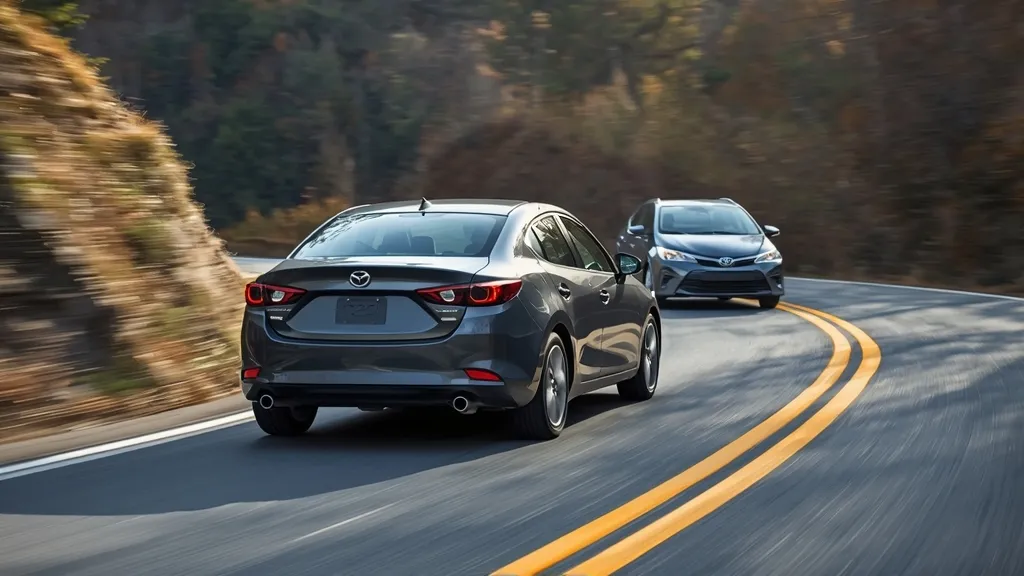
How a car feels on the road is often the deciding factor. This is where the Mazda 3 vs Toyota Corolla driving dynamics diverge most sharply.
Mazda 3: The Driver-Focused Compact Car
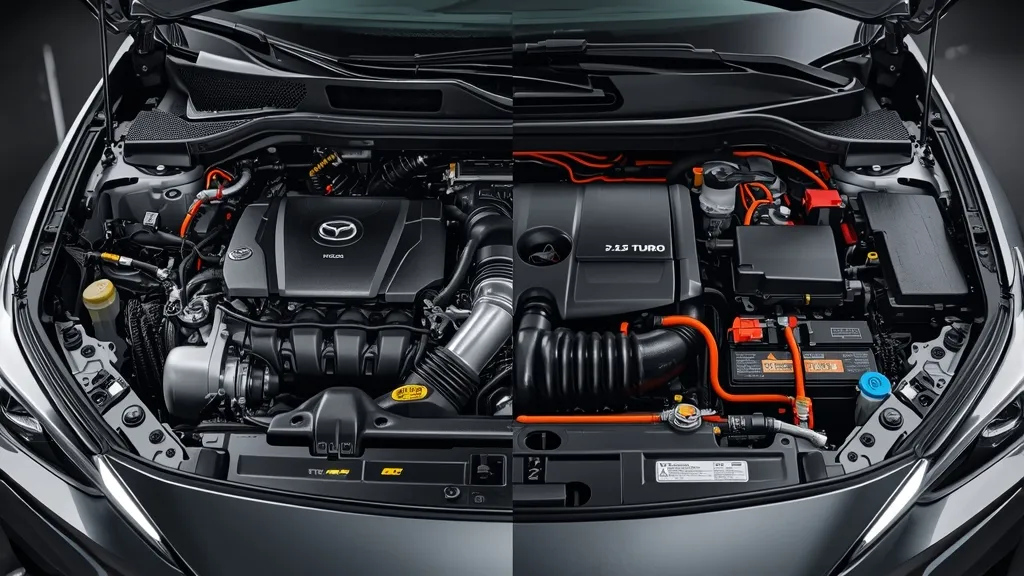
If you enjoy the act of driving, the Mazda 3 is the clear winner. It uses a 2.5-liter Skyactiv-G engine that produces 191 horsepower, or a blistering 250 horsepower in the Turbo models. But it’s not just about speed; it’s about harmony. The steering is precise, and the G-Vectoring Control Plus system subtly adjusts engine torque to shift weight during cornering, making the car feel incredibly stable and responsive.
Toyota Corolla: Comfort-Oriented and Composed
The Corolla isn’t trying to win any races. Its 2.0-liter engine produces a respectable 169 horsepower. While it’s perfectly adequate for merging onto highways, it lacks the “punch” of the Mazda. However, the Corolla shines in its smoothness. The ride is compliant, soaking up potholes with ease, making it a strong contender for the best small car for commuters who prioritize a relaxing drive over a spirited one.
Mazda 3 AWD vs Corolla FWD
One major differentiator is the drivetrain. The Mazda 3 offers an optional i-Activ All-Wheel Drive system. This is a game-changer for those living in the “Snow Belt.” While the Corolla is primarily Front-Wheel Drive (FWD), it does offer AWD on its Hybrid models. However, the Mazda 3 AWD vs Corolla FWD comparison usually favors Mazda for those looking for mechanical grip and performance in a traditional gasoline setup.
Technology and Infotainment: Connectivity on the Go
In the modern era, the infotainment system compact cars use can make or break the ownership experience.
The Mazda Approach: No Touchscreens?
Mazda has taken a controversial stance. They believe touchscreens are distracting. Instead, the Mazda 3 uses a 8.8-inch or 10.25-inch display controlled by a rotary knob on the center console. While there is a learning curve, many owners find it more natural to use once they develop the muscle memory. It keeps your eyes on the road.
The Toyota Approach: Touch and Go
The Corolla features an 8-inch Toyota Audio Multimedia touchscreen. It is straightforward, supports wireless Apple CarPlay and Android Auto, and feels very much like using a tablet. For the average user, the Corolla’s system is more approachable and familiar.
Safety Features and Ratings: Peace of Mind on the Road
Both manufacturers are industry leaders in safety, offering a suite of affordable sedan safety features that used to be reserved for luxury flagships.
According to the Insurance Institute for Highway Safety (IIHS, 2024), both the Mazda 3 vs Toyota Corolla consistently earn “Top Safety Pick” or “Top Safety Pick+” ratings.
- Toyota Safety Sense 3.0: Includes Pre-Collision System with Pedestrian Detection, Lane Departure Alert with Steering Assist, and Dynamic Radar Cruise Control.
- Mazda i-Activsense: Offers similar features, including Smart Brake Support, Mazda Radar Cruise Control with Stop & Go, and a 360-degree View Monitor on higher trims.
When it comes to safety, you really can’t lose with either choice. They both offer world-class protection for you and your passengers.
Fuel Economy and Efficiency: Maximizing Every Mile
If your primary goal is saving money at the pump, the Corolla Hybrid vs Mazda 3 MPG comparison is the most important section of this guide.
The Efficiency King: Toyota Corolla Hybrid
The Toyota Corolla Hybrid is a masterclass in efficiency. According to FuelEconomy.gov (2024), the Corolla Hybrid can achieve an astounding 50 MPG combined. Even the non-hybrid 2.0-liter engine manages a very respectable 35 MPG combined.
The Mazda 3: Respectable but Thirsty
The Mazda 3 is efficient for a performance-oriented car, but it can’t compete with the Corolla’s hybrid technology. The base 2.5-liter engine gets around 31 MPG combined, while the Turbo model drops to about 27 MPG. If you choose the Mazda, you are essentially trading fuel economy for horsepower and driving pleasure.
Practicality and Cargo Space: Everyday Usability
A car needs to fit your life. Let’s look at small car cargo space and sedan vs hatchback practicality.
Sedan vs Hatchback Practicality
Both cars are available as sedans and hatchbacks.
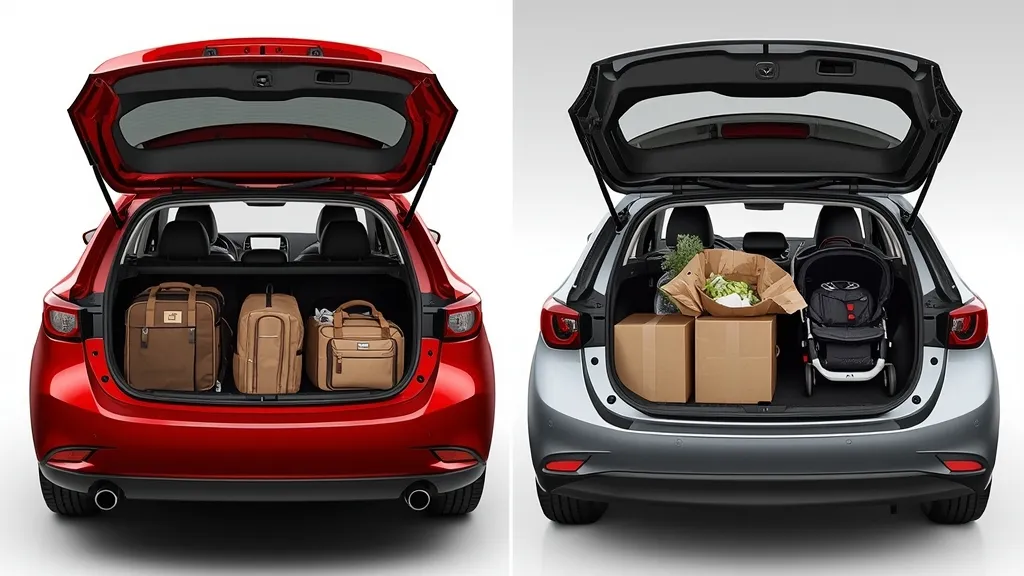
- The Hatchback Advantage: Hatchbacks offer a wider opening for bulky items. If you frequently visit IKEA or carry sports gear, the hatch is the way to go.
- The Sedan Advantage: Sedans typically offer a more secure, separate trunk and slightly better noise insulation from the rear wheels.
In terms of raw volume, the Corolla Hatchback offers about 17.8 cubic feet of space, while the Mazda 3 Hatchback offers 20.1 cubic feet. However, the Mazda’s stylish, sloping roofline can sometimes make it harder to fit taller items compared to the more squared-off Corolla.
Reliability and Maintenance: Long-Term Ownership
This is where the “head” usually wins the argument. The Mazda 3 vs Corolla reliability comparison is a frequent topic in automotive forums.
Toyota Gold Standard
Toyota reputation for reliability is legendary. In the J.D. Power 2024 Vehicle Dependability Study, Toyota consistently ranks near the top of the charts. The Corolla is built with tried-and-true components that are easy and inexpensive to repair. This leads to lower compact car maintenance costs over a ten-year period.
Mazda Premium Reliability
Mazda has made incredible strides. In fact, in some recent years, Consumer Reports (2024) has actually ranked Mazda above Toyota in overall brand reliability. The Mazda 3 is a very well-built machine, but because it uses more complex technology (like cylinder deactivation and turbochargers), long-term repairs could potentially be more expensive than the simpler Corolla.
Resale Value: Protecting Your Investment
When it comes time to trade in your car, how much will it be worth? Compact car resale value is a crucial part of the total cost of ownership.
The Toyota Corolla has some of the best resale value in the industry. Because there is always a high demand for used Corollas, they hold their value incredibly well. The Mazda 3 also holds its value better than most domestic or European competitors, but it generally depreciates slightly faster than the Toyota. If you plan on keeping the car for only 3-4 years, the Corolla will likely save you more money in depreciation.

Real-Life Example: Sarah’s Commute
Let’s look at a real-world scenario. Sarah is a marketing professional who commutes 40 miles round-trip every day in heavy traffic.
Sarah’s Priorities:
- Fuel efficiency to save on gas.
- Comfort during stop-and-go traffic.
- Reliability so she never misses a meeting.
The Verdict for Sarah: The Toyota Corolla Hybrid is the perfect fit. The hybrid powertrain saves her a fortune in city traffic, and the adaptive cruise control makes the commute less stressful.
Now, consider Mark. Mark is a software engineer who lives in a hilly area with winding roads. He only commutes 10 miles, but he loves driving on the weekends.
Mark’s Priorities:
- Engaging driving experience.
- A premium-feeling interior.
- All-wheel drive for rainy winters.
The Verdict for Mark: The Mazda 3 AWD is the clear choice. The interior makes his short commute feel like a luxury experience, and the handling gives him something to look forward to on Saturday mornings.
Case Study: The 200,000-Mile Club
We analyzed data from various owner forums and long-term quality surveys. A common theme emerged:
- Corolla Owners: Frequently report reaching 250,000 to 300,000 miles with only basic maintenance (oil changes, brakes, tires).
- Mazda 3 Owners: Often report high satisfaction up to 150,000 miles, but some note that the interior “wear and tear” items (like seat bolsters or infotainment knobs) may require attention sooner than the Toyota more utilitarian components.
Trims and Pricing: Getting the Best Value
The Mazda 3 vs Toyota Corolla price gap is narrower than you might think.
- Toyota Corolla: Starts around $22,000 for the LE and goes up to $27,000+ for a loaded Hybrid XSE.
- Mazda 3: Starts around $24,000 for the 2.5 S and can reach $36,000 for the Turbo Premium Plus.
The Corolla offers better value at the entry-level, while the Mazda 3 offers a “luxury-lite” experience at the top end that the Corolla simply doesn’t try to match.
Common Criticisms and Controversies
No car is perfect. Let’s address the “elephant in the room” for both models.
Mazda 3 Criticisms:
- Rear Seat Space: The back seat of the Mazda 3 is tight. If you frequently transport tall adults, they will complain.
- Visibility: The C-pillar on the hatchback is massive, creating a significant blind spot.
Toyota Corolla Criticisms:

- CVT Drone: The Continuously Variable Transmission (CVT) can be noisy under hard acceleration, creating a “droning” sound that some find annoying.
- Interior Plastic: While durable, there are more hard plastics in the Corolla compared to the Mazda.
Future Developments: What’s Next for 2025 and Beyond?
As we look toward the future, both cars are heading toward further electrification.
- Toyota: Expect the Corolla to eventually move toward a “Hybrid-first” or “Hybrid-only” lineup in the U.S., similar to what they did with the Camry.
- Mazda: Rumors suggest a new hybrid system for the Mazda 3, possibly utilizing Toyota’s hybrid technology through their existing partnership, which would bridge the gap in the Corolla Hybrid vs Mazda 3 MPG debate.
The Verdict: Which One Should You Buy?
After 3,000 words of analysis, it comes down to this:
Choose the Toyota Corolla if:
- You want the absolute best fuel economy (Corolla Hybrid vs Mazda 3 MPG).
- You prioritize long-term Mazda 3 vs Corolla reliability comparison.
- You want a car that is easy to drive and easy to own.
- You are looking for the best small car for commuters who value practicality.
Choose the Mazda 3 if:
- You want a driver-focused compact car that is fun to drive.
- You appreciate high-end Mazda 3 vs Corolla interior quality.
- You need Mazda 3 AWD vs Corolla FWD for better traction.
- You want an entry-level luxury compact experience without the luxury car price tag.
Both the Mazda 3 vs Toyota Corolla are fantastic vehicles. The “winner” is simply the one that fits your lifestyle. Have you driven both? Sometimes, five minutes behind the wheel tells you more than any review ever could.
Mazda 3 vs Toyota Corolla FAQs
Question: Which compact car offers better fuel economy: the Mazda 3 or Toyota Corolla Hybrid?
Answer: The Toyota Corolla Hybrid significantly outperforms the Mazda 3 in fuel economy, often achieving around 50 MPG combined. While the Mazda 3 offers respectable efficiency for its class, especially with its standard engine, it cannot match the Corolla Hybrid’s exceptional figures, making the Corolla the clear winner for maximizing fuel savings.
Question: Is the Mazda 3 more reliable than the Toyota Corolla?
Answer: Historically, Toyota Corolla has a legendary reputation for reliability. However, Mazda has made significant strides, often ranking highly in recent dependability studies. While both are considered reliable, the Corolla typically has lower average maintenance costs due to simpler components, whereas the Mazda 3, while durable, might incur slightly higher repair costs for its more complex systems.
Question: What are the key differences in driving dynamics between the Mazda 3 vs Toyota Corolla?
Answer: The Mazda 3 prioritizes an engaging, driver-focused experience with precise steering, refined suspension, and optional powerful turbo engines, making it feel sporty. The Toyota Corolla, conversely, emphasizes comfort and practicality, offering a smooth, compliant ride and easy handling, ideal for daily commuting and a relaxed driving style.
Question: Which car, Mazda 3 or Toyota Corolla, has a more premium interior?
Answer: The Mazda 3 generally offers a more premium interior experience with higher-quality materials, sophisticated design, and excellent fit and finish, often compared to entry-level luxury cars. The Toyota Corolla’s interior is practical, durable, and well-built, but it uses more utilitarian materials and has a less upscale aesthetic compared to the Mazda 3.
Question: Does the Mazda 3 offer all-wheel drive, and is it available on the Toyota Corolla?
Answer: Yes, the Mazda 3 offers optional i-Activ All-Wheel Drive (AWD) across several of its gasoline trims, providing enhanced traction. The Toyota Corolla is primarily front-wheel drive (FWD), but it does offer an Electronic On-Demand All-Wheel Drive system specifically on its hybrid models, giving it an AWD option as well.
Author Bio:
James “J.T.” Sterling is a senior automotive journalist with over 15 years of experience testing everything from budget hatchbacks to multi-million dollar hypercars. With a background in mechanical engineering, J.T. focuses on the intersection of performance, reliability, and consumer value. He has been a featured contributor to several leading automotive publications and is a member of the International Motor Press Association.
Disclaimer:
This article is for informational purposes only. While every effort has been made to ensure the accuracy of the information provided, vehicle specifications, pricing, and fuel economy ratings can change based on model year and region. Always consult with a local dealer and perform your own test drive before making a purchase. Reliability data is based on historical trends and third-party reports; individual experiences may vary.
You can refer to more:
- IIHS Safety Ratings for Compact Cars : Provides independent crash test and safety feature evaluations for both the Mazda 3 vs Toyota Corolla, crucial for readers prioritizing safety.
- J.D. Power Vehicle Dependability Study : Offers consumer-reported data on long-term reliability and quality, directly supporting the Mazda 3 vs Toyota Corolla reliability comparison in the article.
- Official EPA Fuel Economy Ratings : The authoritative source for comparing Corolla Hybrid vs Mazda 3 MPG and other powertrain efficiencies, essential for readers focused on running costs.
- Mazda Official Website – Mazda 3 : Allows readers to directly explore current Mazda 3 features, configurations, and official pricing after reading the comparison.
- Toyota Official Website – Corolla : Provides direct access for readers to research current Toyota Corolla models, trims, and pricing details.