
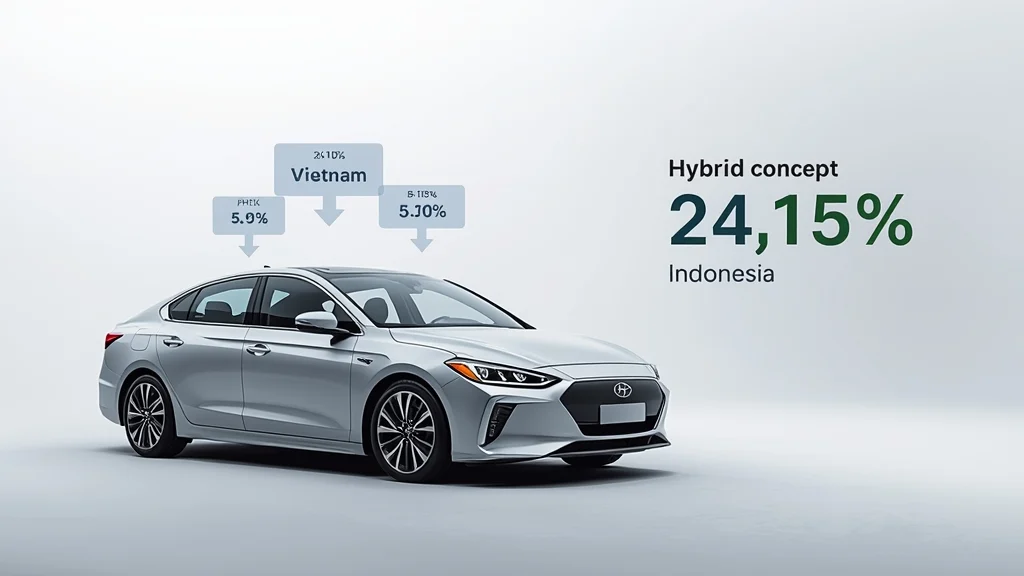
Explore Vietnam, Thailand and Indonesia’s hybrid car tax incentives, rates and eligibility. Discover which market gives the biggest savings – read now!
Hybrid vehicles are gaining momentum across Southeast Asia, and governments are using tax policies to accelerate adoption. Vietnam, Thailand and Indonesia all offer special excise or luxury taxes for plug‑in hybrids (PHEV), self‑charging hybrids (HEV) and mild hybrids (MHEV), but the exact rates and eligibility rules differ quite a bit.
2026 Tax Incentive Snapshot
All three countries calculate the incentive as a percentage of the vehicle’s pre‑tax price. The table below summarizes the headline rates for each market.
| Country | Typical Hybrid Tax Rate | Reference Fuel‑Vehicle Tax | Key Conditions |
|---|---|---|---|
| Vietnam | 24.5‑105 % of vehicle price (70 % of the fuel‑car tax) | 35‑150 % (based on engine size and CO₂ emissions) | Hybrid must use ≤70 % of the fuel energy of an equivalent ICE vehicle. |
| Thailand | 5‑10 % (equivalent to 30‑50 % of fuel‑car tax) | 14‑34 % for gasoline cars, up to 50 % for >3 L or luxury models | Rate varies by CO₂ output; additional local‑content and investment commitments required. |
| Indonesia | Under 10 % of fuel‑car tax (luxury sales tax – PPnBM) | 10‑40 % for sub‑3 L gasoline cars; 40‑125 % for larger engines | Applies only to domestically assembled models certified under the low‑emission program. |
How Vietnam Calculates the Hybrid Tax
Vietnam’s upcoming hybrid tax incentive (effective 2026) is tied to Decree 360/2025. The government compares the fuel consumption of a hybrid (HEV) to the average fuel consumption of a conventional internal‑combustion engine (ICE) car of the same displacement. If the hybrid’s fuel‑energy share does not exceed 70 % of the ICE benchmark (known as the “R‑ratio”), the vehicle qualifies for a special consumption tax set at 70 % of the standard ICE rate.
- R ≤ 70 % → hybrid taxed at 70 % of the ICE tax bracket.
- The Ministry of Construction publishes the reference ICE fuel‑efficiency figures each year before March 31.
Thailand’s Tiered Incentive Structure
Thailand uses an Excise Tax system that rewards lower CO₂ emissions and local content. The main brackets are:
- MHEV: 10 % tax if CO₂ ≤ 100 g/km (≈ 4.3 L/100 km); 12 % if 101‑120 g/km.
- HEV: 6 % tax if CO₂ ≤ 100 g/km; 9 % if 101‑120 g/km.
- PHEV: 5 % tax for electric‑only range ≥ 80 km; 10 % for shorter electric range.
Additional requirements include 17‑45 % local parts content (depending on vehicle type) and a minimum investment of US$84 million between 2024‑2027 to support domestic hybrid production.
Indonesia’s Luxury Sales Tax (PPnBM) Rules
Indonesia treats hybrids as a luxury‑goods category but offers a reduced PPnBM rate when specific criteria are met:
- Vehicle must be manufactured or assembled locally.
- Must be certified under the government’s Low‑Carbon Emission Vehicle (LCEV) program.
- Fuel consumption caps: ≤ 6.45 L/100 km for gasoline hybrids, ≤ 5.71 L/100 km for diesel hybrids.
- At least 40 % of components must be sourced domestically.
Comparative Takeaways
While Thailand and Indonesia currently present the deeper tax discounts, they also attach stricter conditions—higher local‑parts thresholds, sizable investment commitments, and, in Indonesia’s case, a mandatory domestic assembly requirement. Vietnam’s framework is simpler but offers a narrower discount, hinging primarily on fuel‑efficiency performance.
Automakers looking to optimise pricing across the region will need to balance the magnitude of the tax break against the cost of meeting each country’s localisation and certification demands.
What This Means for Buyers
If you’re shopping for a hybrid in Southeast Asia, consider not only the headline tax rate but also the total cost of compliance that manufacturers embed in the sticker price. In Thailand, the generous tax cut may be offset by higher local‑content costs, whereas Indonesia’s reduced luxury tax applies only to locally built models.
Vietnam’s upcoming policy could level the playing field for imported hybrids, but the actual saving will depend on how efficiently a model meets the 70 % fuel‑energy benchmark.
Stay tuned for the final regulations in each market, as governments have signalled they will tweak rates as adoption grows and market conditions evolve.