
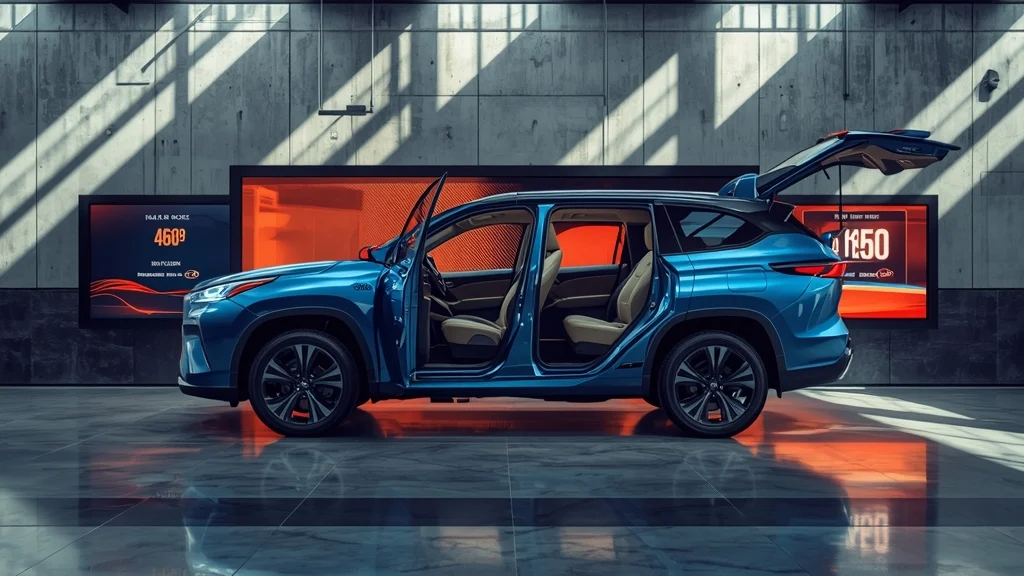
Discover the all‑new 2027 Toyota Highlander EV – larger dimensions, advanced tech, and up to 492 km range. Learn more and stay ahead of the EV curve!
Toyota has officially unveiled the 2027 Highlander EV, a fully electric three‑row SUV that builds on the brand’s new BZ design language while offering significantly larger dimensions and a suite of cutting‑edge technologies.
Design and Exterior Dimensions
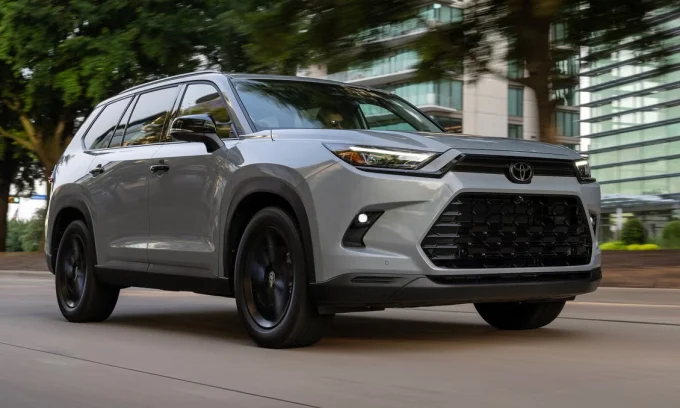
The new Highlander EV adopts a more angular silhouette compared with the current gasoline model. The rear hips are less rounded, and the traditional front grille is replaced by a clean, closed‑off air intake. A smaller lower grille directs airflow to the battery pack and motor for cooling.
Overall, the vehicle grows by 99 mm in length, 58 mm in width, and 20 mm in height. The most dramatic change is a 200 mm longer wheelbase, bringing the total dimensions to 5,049 mm (L) × 1,988 mm (W) × 1,709 mm (H) with a 3,050 mm wheelbase. The expanded cabin translates into easier access to the third row and more flexible battery placement.
Interior and Comfort
Inside, Toyota focuses on simplicity around a 14‑inch infotainment screen and a 12.3‑inch digital instrument cluster. Physical buttons remain for essential functions such as climate control.
Both the XLE and Limited trims come standard with SofTex‑wrapped seats, heated front seats, and 64‑color ambient lighting. A panoramic roof is optional on the XLE and standard on the Limited – the largest Toyota has ever offered.
The second‑row seats feature a captain’s chair layout as standard. XLE AWD buyers can opt for a bench seat, raising capacity from six to seven passengers. The third row is designed to accommodate adults comfortably, equipped with USB‑C ports, climate vents, and adjustable lumbar support.
Cargo space reaches 1,292 L with the third row folded and 450 L with all seats upright, making the Highlander EV spacious, though still shy of the gasoline Grand Highlander’s 1,614 L behind the second row.
Powertrain and Performance
All 2027 Highlander EVs are electric, but buyers can choose between front‑wheel‑drive (FWD) and all‑wheel‑drive (AWD) configurations, as well as two battery sizes.
- XLE FWD: 77.0 kWh battery, ~400 km (250 mi) WLTP range, 221 hp, 268 Nm torque.
- XLE AWD: Same 77.0 kWh battery, ~422 km (262 mi) range. Option to upgrade to a 95.8 kWh pack for up to ~492 km (306 mi) range.
- Limited AWD: Standard 95.8 kWh battery, ~492 km range, up to 338 hp and 437 Nm torque.
AWD models also gain off‑road terrain selection and hill‑descent control, features seldom seen on electric SUVs.
Charging and Technology
The Highlander EV is equipped with a NACS‑compatible DC fast‑charging port, allowing 10‑80 % charging in roughly 30 minutes under ideal conditions. A dual‑voltage home charger, pre‑conditioned battery heating, and Plug‑&‑Charge capability are included.
One standout tech feature is Vehicle‑to‑Load (V2L), which lets the SUV power external tools or serve as an emergency backup power source—ideal for work sites or outages.
Safety Suite
Safety Sense 4.0 debuts on the Highlander EV, featuring updated driver‑assist functions such as pre‑collision braking, adaptive cruise control, lane‑keeping assist, and autonomous driving support. The Limited trim adds traffic jam assist, advanced parking assistance, a full‑surround camera, and lane‑changing aid.
Production, Availability, and Pricing
The 2027 Highlander EV will be the first Toyota electric SUV built in the United States, with production slated to start in late 2026 at the Georgetown, Kentucky plant—currently home to the Camry sedan. Batteries will be supplied by Toyota’s new $13.9 billion factory in Liberty, North Carolina, which began operations in late 2025.
Dealers in the U.S. are expected to receive the vehicle in early 2027, possibly sooner. Pricing details have not been announced yet.
With its larger footprint, versatile interior, and competitive electric range, the 2027 Toyota Highlander EV aims to challenge established EV SUVs while preserving the family‑friendly ethos of the Highlander nameplate.