
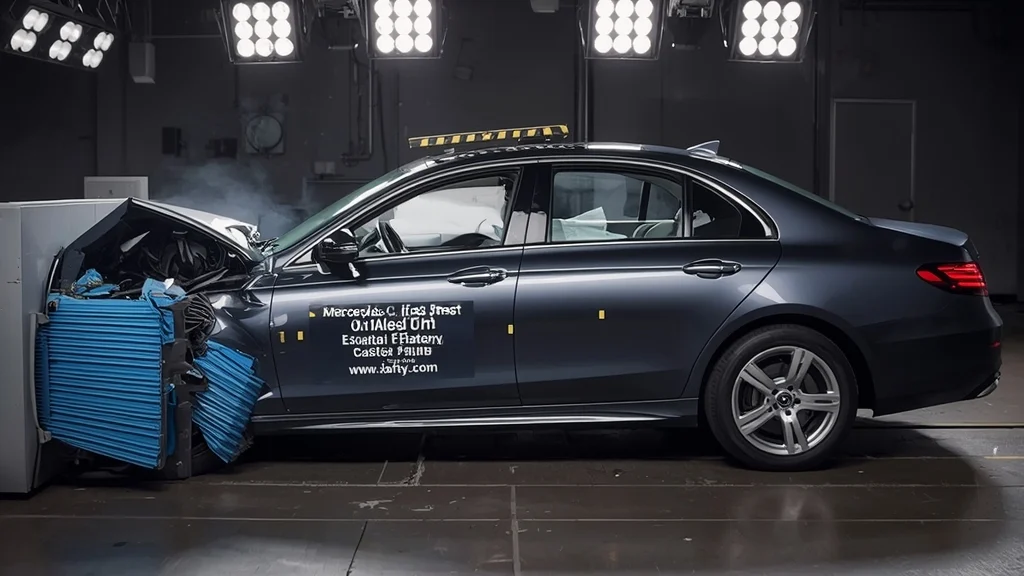
New Mercedes E-Class 2026 receives a ‘Marginal’ safety rating from IIHS. Learn why rear passenger protection is a concern and stay informed!
The latest Mercedes-Benz E-Class (2026 model) hasn’t achieved top safety marks in recent testing by the Insurance Institute for Highway Safety (IIHS). The luxury sedan received a ‘Marginal’ rating – a relatively low score – in the moderate overlap front crash test.
What is the IIHS Moderate Overlap Front Crash Test?
The IIHS moderate overlap front crash test simulates a common accident scenario where 40% of the driver’s side of the vehicle strikes a fixed barrier at approximately 40 mph (64 km/h). Since 2022, the IIHS has updated its evaluation methods to include a rear passenger dummy. This addition allows for a more comprehensive assessment of occupant protection, particularly for those in the back seats during real-world collisions.
Key Findings from the E-Class 2026 Crash Test
During the test, the passenger compartment of the 2026 Mercedes-Benz E-Class maintained a relatively stable structure. Both the front airbags and side curtain airbags deployed as expected. However, data collected from the rear passenger dummy revealed a concerning issue: the seatbelt tended to slide up towards the abdomen rather than remaining securely positioned across the pelvis.
This upward movement of the seatbelt increases the risk of abdominal injuries during a crash. IIHS also recorded head, neck, and chest impact measurements for rear passengers ranging from low to moderate levels. Fortunately, the rear shoulder belt remained in the correct position, helping to mitigate the risk of more severe injuries.
Other Safety System Evaluations
Beyond the front crash test, the IIHS evaluated other safety features on the 2026 Mercedes-Benz E-Class. The standard LED headlights received ratings ranging from “acceptable” to “expected,” with higher-end headlight configurations performing better. The automatic emergency braking system also earned an “acceptable” rating in simulated crash scenarios involving other vehicles and pedestrians.
Why the Lower Rating?
These results prevent the 2026 Mercedes-Benz E-Class from achieving the IIHS’s highest safety rating. The IIHS is increasingly focused on rear passenger protection, reflecting a growing understanding of the risks faced by occupants in the back seats – an area that historically received less attention in vehicle safety design.
The updated testing standards aim to more accurately reflect real-world accident scenarios. The IIHS emphasizes that these stricter standards are necessary to improve overall vehicle safety.
What’s Next for Mercedes-Benz?
As of now, Mercedes-Benz has not announced any plans to modify the E-Class’s structure or safety systems to improve its performance in future IIHS tests. It remains to be seen whether the automaker will address these concerns in subsequent model year updates.