
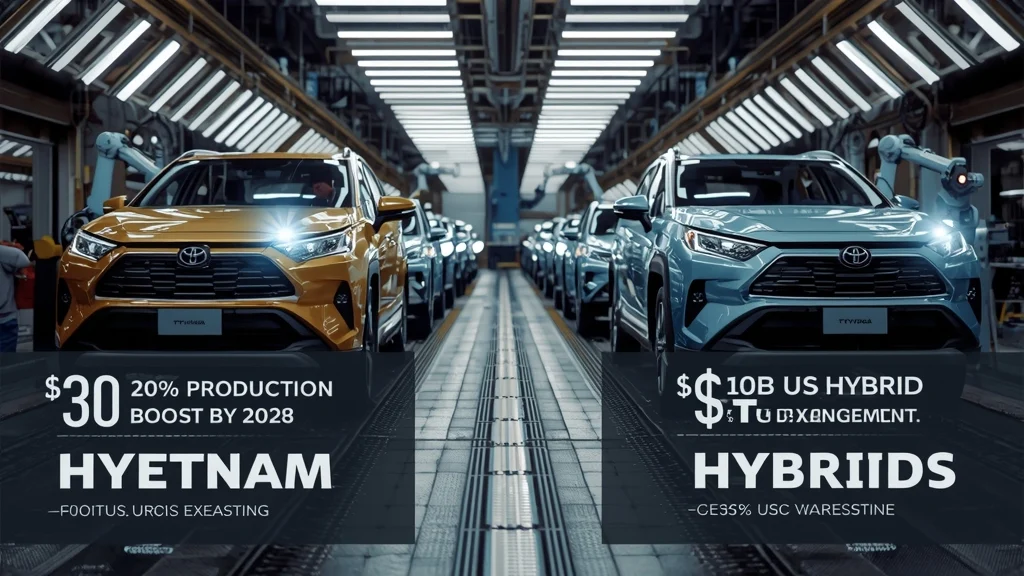
Toyota plans a 30% increase in hybrid production by 2028, targeting 60% of global output as EV demand wanes. Learn more now.
In a bold shift that reflects the changing dynamics of the automotive market, Toyota announced a plan to lift its global hybrid output by roughly 30% by 2028. The Japanese automaker aims to produce around 6.7 million hybrid vehicles—including plug‑in hybrids—by that year, positioning hybrids at about 60% of its total worldwide production.
Why the pivot to hybrids?
Recent data shows a softening of electric‑vehicle (EV) demand in several key regions. In Europe, the European Union is trimming its EV incentive programmes, while the United States has eliminated many tax credits for EV purchases, according to the Bangkok Post. With governments pulling back support, Toyota is recalibrating its strategy to lean more heavily on hybrid technology, which still enjoys strong consumer acceptance and lower regulatory barriers.
Investment boost in the United States
Earlier this month, Toyota disclosed a fresh US investment of up to $10 billion over the next five years. The capital infusion is earmarked for expanding hybrid‑vehicle production capacity, underscoring the company’s confidence that hybrids will remain a cornerstone of its lineup in North America.
Global production targets
The automaker’s ambitious goal is to raise its total vehicle output—encompassing gasoline, hybrid, and EV models—to roughly 11.3 million units by 2028. Currently, hybrids already account for more than 40% of Toyota’s worldwide sales, amounting to about 10.5 million units in 2025.
Hybrid performance in Vietnam
In the Vietnamese market, two Toyota hybrids topped the 2025 sales charts. The Innova Cross Hybrid led with 3,021 units, followed closely by the Corolla Cross Hybrid at 2,926 units. The Camry Hybrid held the fifth spot with 1,595 units, trailing the Suzuki XL7 Hybrid (2,632) and the Honda CR‑V e:HEV (1,888).
What this means for the future
By reallocating resources toward hybrid technology, Toyota is positioning itself to capture a larger slice of a market where full‑electric adoption is progressing more slowly than anticipated. The strategy not only hedges against policy fluctuations but also leverages the brand’s long‑standing expertise in hybrid powertrains.
Consumers worldwide can therefore expect a broader selection of efficient, low‑emission vehicles from Toyota in the coming years—whether they prefer a plug‑in hybrid for occasional electric driving or a conventional hybrid for everyday convenience.