
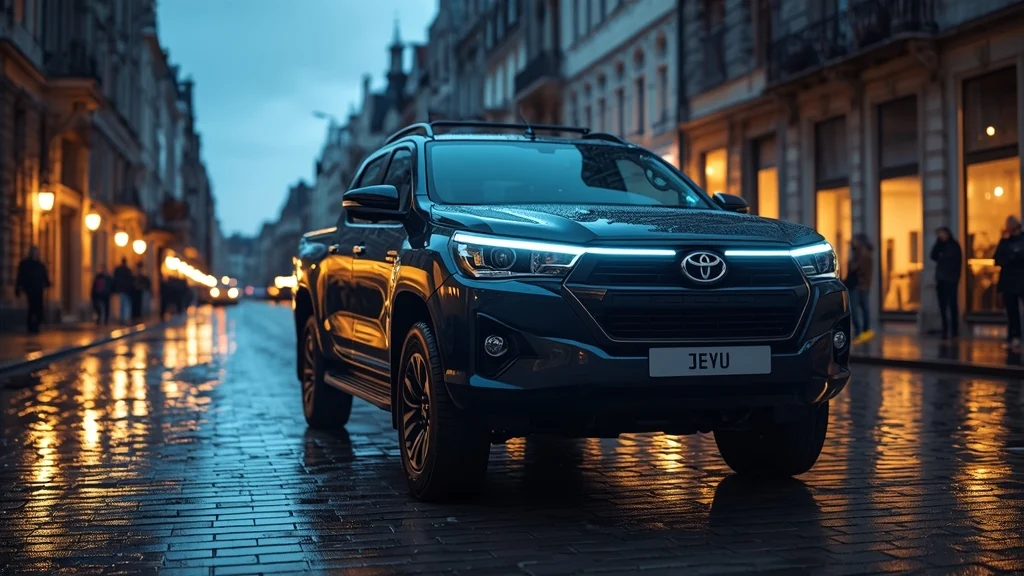
Discover the all‑new Toyota Hilux electric pickup, now unveiled for demanding European markets with BEV and hybrid options. Learn more today!
European debut at the Brussels Motor Show
At the recent Brussels Motor Show, Toyota introduced the ninth‑generation Hilux for the European market, offering a mild‑hybrid diesel and a fully electric BEV version. Both models were previously launched in Asia, but their arrival in Europe signals Toyota’s push into markets with strict emissions rules.
Powertrain lineup: diesel, hybrid and BEV
The electric‑only Hilux BEV marks the first time the iconic pickup has a zero‑emission variant. Toyota also confirmed development of a hydrogen‑fuel‑cell version, showcasing a multi‑track strategy during the industry’s transition period.
For most customers, the traditional 2.8‑liter diesel mild‑hybrid (201 hp) remains available. In several European countries, a non‑hybrid diesel option will still be offered, with a 48 V system expected to stay the mainstay alongside the electric model. The diesel can haul up to 1,000 kg and tow 3,500 kg.
Hilux BEV – specifications and performance
The BEV is aimed at business users focused on operating costs and tax incentives. It houses a 59.2 kWh battery and dual electric motors on each axle, delivering permanent all‑wheel drive. The front motor produces 205 Nm of torque, while the rear provides 268 Nm.
According to WLTP testing, the electric Hilux achieves a range of about 258 km (≈160 mi); in city driving the range can stretch to roughly 380 km (≈236 mi). While respectable for a pickup, the range is modest compared with many passenger EVs, which may limit its appeal in markets like Vietnam.
Off‑road capability preserved
Despite the electric drivetrain, the BEV retains the Hilux’s core off‑road traits: a body‑on‑frame chassis, 212 mm ground clearance and water‑wading depth of up to 700 mm. An exclusive off‑road drive mode leverages instant torque and regenerative braking. However, payload drops to 715 kg and maximum tow capacity reduces to 1,600 kg, notably lower than the internal‑combustion models.
Design language – the “Cyber Sumo” look
Both hybrid and electric versions adopt Toyota’s new “Cyber Sumo” design, developed by the Australian team. The styling emphasises bold, angular surfaces and a modern, large‑pickup silhouette. The electric model is identifiable by a closed‑cell grille and reshaped front bumper.
Upgraded interior and tech
The cabin receives a technology boost with a 12.3‑inch digital instrument cluster, a centrally mounted infotainment screen of the same size, and a steering wheel borrowed from the latest Land Cruiser. Standard safety suites are carried over, while many frequently‑used controls remain physical buttons for tactile feedback.
Market rollout and pricing
Toyota plans to start selling the new Hilux in the United Kingdom from June, with official pricing – expected to be higher than the current generation – to be announced in the coming months.
Conclusion
The electric Hilux demonstrates Toyota’s commitment to electrifying one of its most rugged nameplates while retaining the off‑road DNA that owners love. Though its range may limit broader adoption, especially in emerging markets, the BEV offers a compelling option for European fleets seeking low‑emission work trucks.