
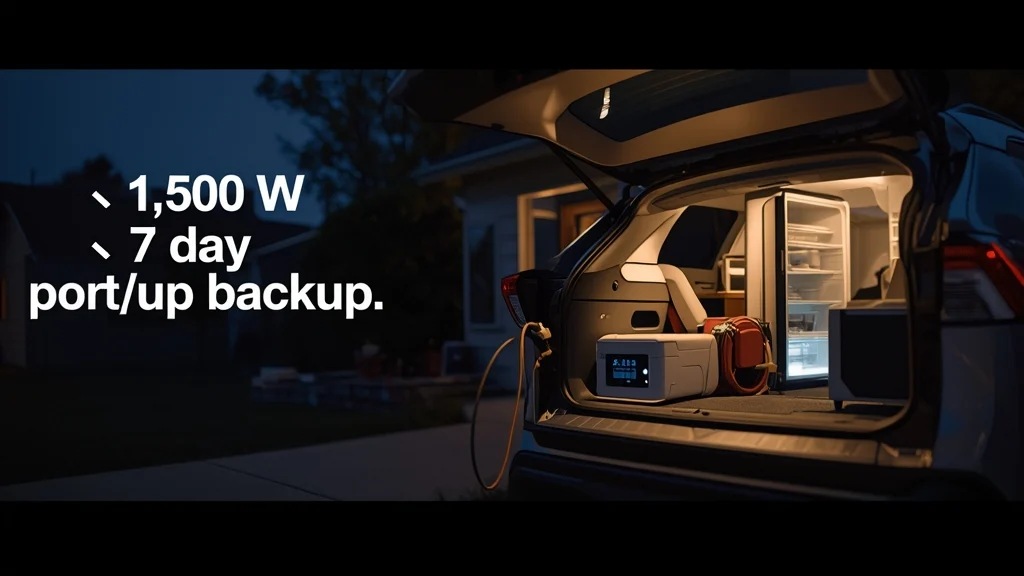
Discover how the 2026 Toyota RAV4 PHEV delivers up to 1,500 W for up to 7 days, turning your SUV into a reliable backup power source. Learn more today!

The 2026 Toyota RAV4 Plug‑in Hybrid (PHEV) is more than a sleek, efficient SUV—it’s also a portable power plant that can keep a household running for up to seven days during an outage.

Why This Matters
Power failures are becoming more frequent worldwide, and having a reliable source of electricity can make the difference between comfort and crisis. Toyota’s latest RAV4 PHEV tackles that challenge head‑on by marrying a hefty battery pack with a gasoline engine that doubles as a generator.

How the Power‑Supply Mode Works
When the vehicle’s 22.7 kWh battery is fully charged and the 2.5‑liter gasoline tank is topped up, drivers can activate the Power Supply Time Priority Mode. In this setting the system first draws energy from the battery to feed external devices. Once the battery drops to a preset low‑level, the gasoline engine automatically starts, recharging the battery while continuing to deliver power.

This cycle can sustain a continuous output of up to 1,500 W (approximately 400 W per outlet) for a full week—enough to run essential appliances such as LED lighting, a mini fridge, Wi‑Fi routers, phone chargers, or basic medical equipment.

Technical Specs at a Glance
- Battery capacity: 22.7 kWh (significantly larger than most current PHEVs)
- Engine: 2.5 L gasoline, acts as a backup generator
- Combined output: 324 hp, all‑wheel drive
- Electric‑only range: ~150 km (93 mi) under Japanese test conditions
- Power outlet locations: Inside the luggage compartment and an external charging port
- Maximum continuous export power: 1,500 W
Beyond the Power Feature: What Else Is New?
The RAV4 PHEV retains its familiar 2.5 L engine paired with two electric motors, but the cabin receives a fresh redesign. Drivers now enjoy a larger central touchscreen with a modern UI, a fully digital instrument cluster, and wireless phone connectivity. Over‑the‑air (OTA) updates keep software, navigation, and even power‑management algorithms current.
Safety is boosted by the latest Toyota Safety Sense suite, adding refined automatic emergency braking, lane‑keeping assistance, and adaptive cruise control with smoother operation. The chassis and suspension have been tuned for better stability, and the sport‑focused GR Sport trim adds aggressive styling cues and a more dynamic driving feel.
Pricing, Availability, and Who Might Need It
Pre‑orders for the new RAV4 PHEV have opened in Japan, with production slated at roughly 700 units per month. The base “Z” model starts at ¥6 million (about $38,000 USD), roughly ¥1.1 million more than a conventional RAV4 hybrid of similar specifications. The GR Sport PHEV, the most premium offering, starts at ¥6.3 million (close to $40,000 USD).
This model is an attractive option for owners in regions prone to natural disasters, rural households with limited grid reliability, or outdoor enthusiasts who want both mobility and a dependable energy source.
Bottom Line
By integrating a sizable battery with a gasoline‑engine generator, Toyota has transformed the RAV4 PHEV into a versatile tool that can serve as transportation, fuel‑efficient commuter, and emergency power supply—all in one vehicle. If you’re looking for an SUV that does more than just get you from point A to point B, the 2026 RAV4 PHEV might be the answer.
Ready to experience a backup power solution that moves with you? Explore the new RAV4 PHEV today.