
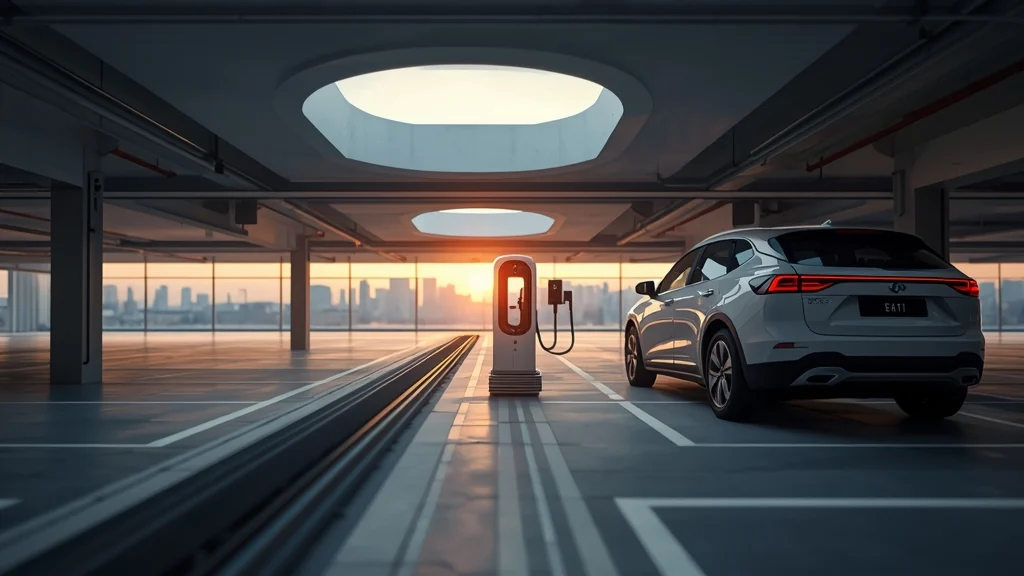
Discover rail‑mounted EV charging robots that simplify parking‑lot charging in China. Explore the tech, benefits, drawbacks, and key players.
China is turning ordinary parking spaces into smart charging hubs with rail‑mounted electric‑vehicle (EV) charging robots. These compact devices glide along overhead tracks, stop above a parked EV, and automatically connect to the vehicle’s charger, eliminating the need for drivers to hunt for an empty plug.
How the System Works
The rails serve a dual purpose: they supply power and act as a guided pathway for the robot. When an EV driver requests a charge—usually through a mobile app, WeChat, or a QR code—the robot rolls to the vehicle, lowers its charging arm, and begins to charge.
Key Advantages
- Infrastructure efficiency: A single high‑voltage line can serve dozens of parking spots, cutting installation costs that can run into thousands of dollars per stall in underground garages.
- Space‑saving design: No bulky wall‑mounted chargers clutter parking aisles, keeping the layout clean and flexible.
- Convenience: Drivers simply request a charge; the robot handles the rest, ideal for offices, shopping malls, or residential garages where cars stay parked for hours.
Limitations
The system delivers AC Level‑2 power, which is slower than dedicated DC fast chargers that can reach 1,000 kW. For long‑duration parking—overnight at home or all‑day at work—the slower but steady charge is acceptable, but it won’t replace high‑speed highway chargers.
Leading Companies and Projects
Li Auto & CGXi claim to be developing the world’s first rail‑based autonomous charging arm. Li Xiang, CEO of Li Auto, confirmed active field trials during the Li i8 launch in July 2025. Their robot combines vision sensors and precise positioning to dock with any compatible EV.
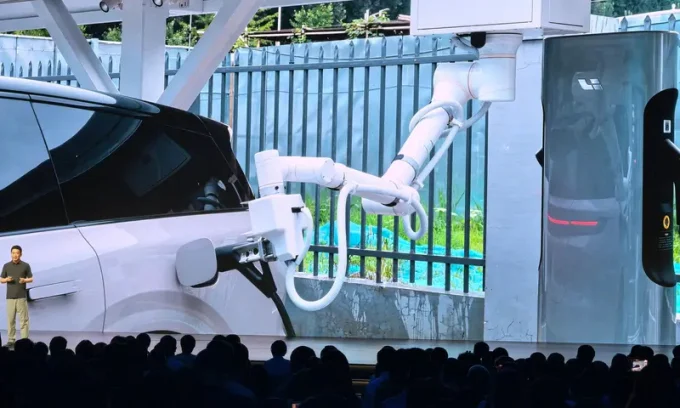
Wawa Robotics introduced the “Robot HAVA,” an 18‑degree‑of‑freedom arm that travels on an “H‑shaped” overhead rail. The company advertises a single unit serving eight or more parking spots, marketing it as the first commercially available automatic charging robot.
SkyvoltRobot published a technical framework in a 2024 ScienceDirect paper, supplying the theoretical foundation for high‑rail charging robots and guiding commercial implementations.
Broader Robot‑Charging Landscape
Rail‑mounted solutions are just one slice of China’s rapid expansion in mobile EV charging. Ground‑based robots from firms such as CharGo (a CATL subsidiary), NaaS Technology, GGSN, and VMR are also scaling up. CharGo’s CEO predicts that robots will handle 20 % of new‑energy vehicle charging by 2030. Beijing alone plans to deploy 1,000 mobile chargers across 150 parking structures.
What This Means for the Global Market
While still in its early stages, rail‑mounted charging robots demonstrate a viable path to retrofit existing parking facilities with smart EV infrastructure without massive rewiring projects. As electric vehicles become ubiquitous, similar systems could appear in metropolitan garages worldwide, offering a blend of convenience and cost‑effectiveness.
Conclusion
Rail‑mounted EV charging robots are redefining how drivers power their cars in dense urban environments. Though limited by slower charging speeds, their infrastructural efficiency and user‑friendly operation make them a compelling addition to the future of electric mobility.