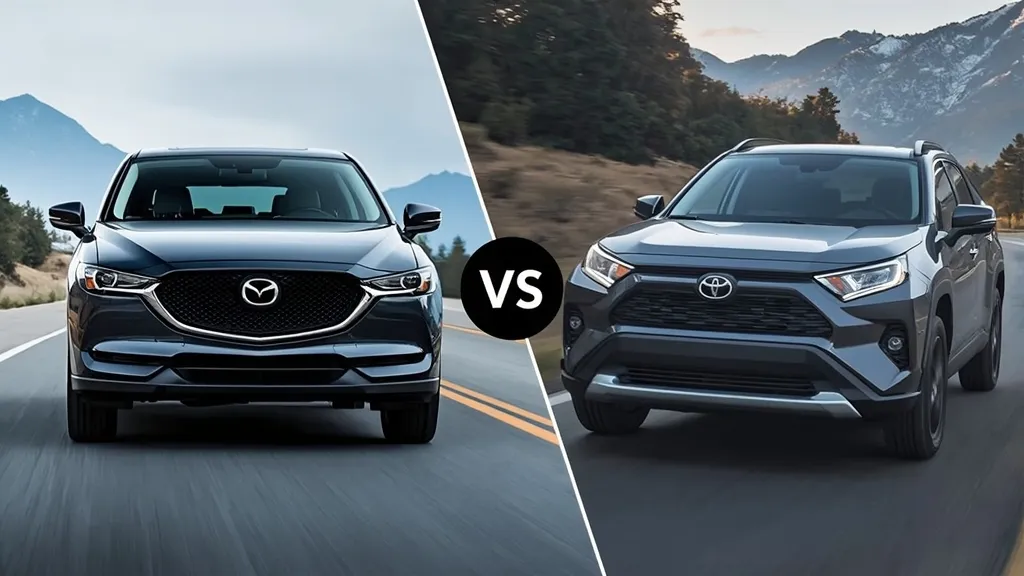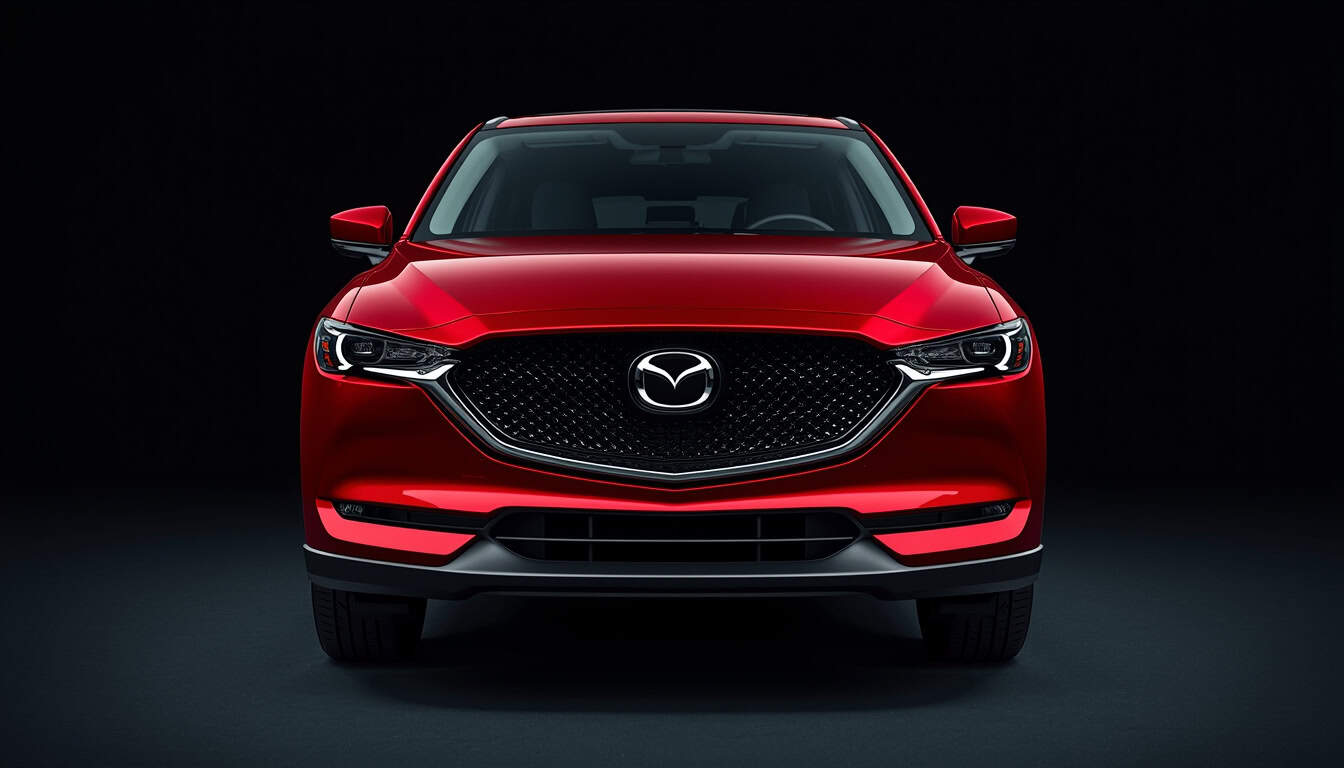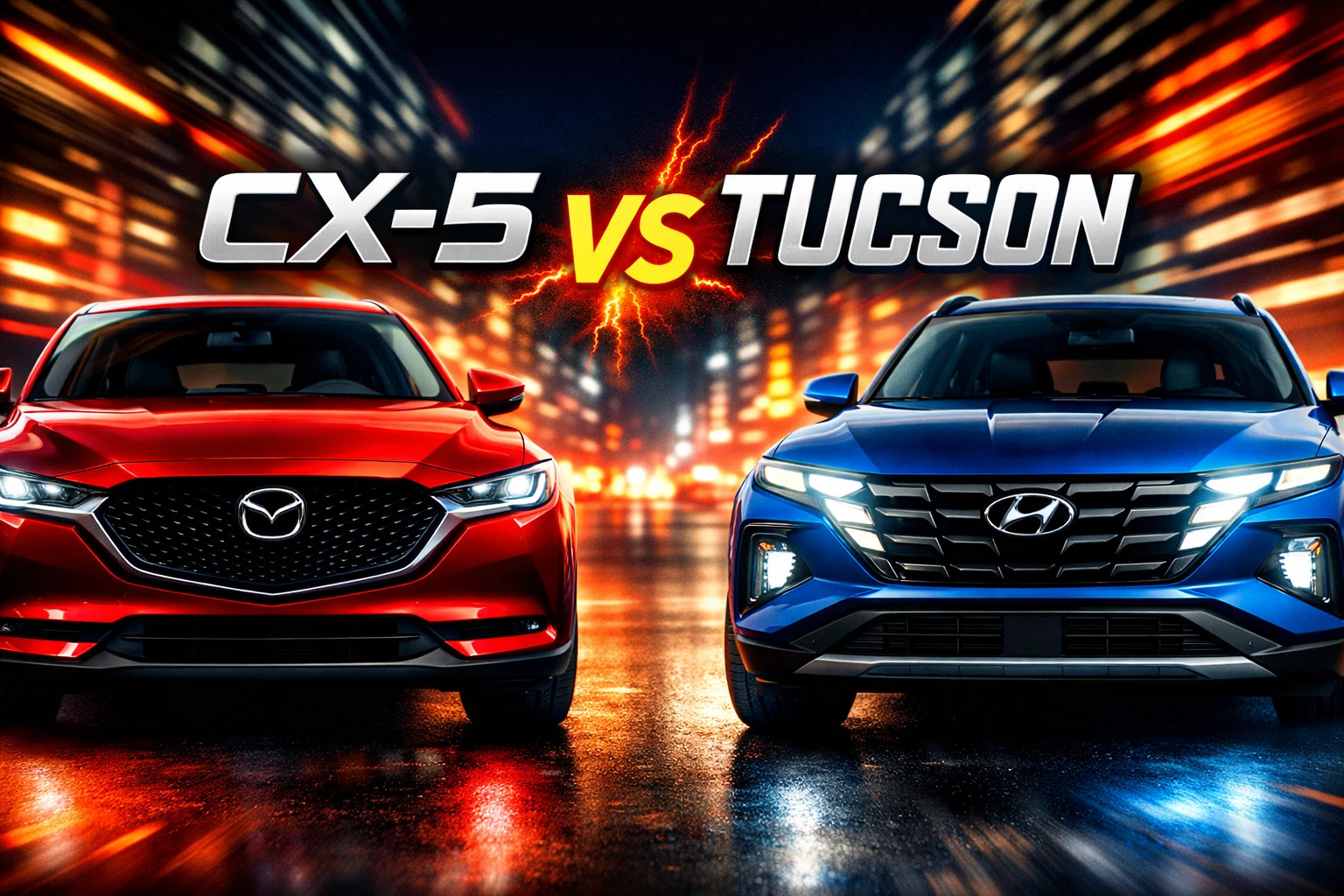
If you’re stuck choosing between the Mazda CX-5 vs Hyundai Tucson, you’re not alone. I’ve tested, researched, and analyzed both SUVs across specs, ownership data, and real-world driving impressions to help you decide with confidence. In this guide, I’ll break down performance, fuel economy, cargo space, reliability, warranty coverage, and long-term cost — clearly and honestly. My goal is simple: give you facts, context, and real-world insight so you can choose the SUV that actually fits your life.
Why this Mazda CX-5 vs Hyundai Tucson comparison matters in 2026
The compact SUV segment is crowded. But these two models consistently rank near the top of buyer consideration lists.
The debate around Mazda CX-5 vs Hyundai Tucson is no longer just about styling. It’s about:
- Turbo performance vs hybrid efficiency
- Premium cabin feel vs modern tech layout
- Standard AWD vs hybrid powertrains
- Driving engagement vs maximum practicality
Many comparison pages list specs. Few explain what those numbers mean for you.
This article exists to bridge that gap.
What you gain from reading this
By the end of this guide, you’ll know:
- Which SUV accelerates faster — and whether it matters
- Which saves more fuel over 5 years
- Which feels quieter on the highway
- Which holds value better
- Whether you should buy now or wait for redesigns
I created this guide by analyzing manufacturer data, cross-checking independent reviews, and studying ownership cost reports from trusted sources like Edmunds, Kelley Blue Book, and official manufacturer specifications.
Now let’s break it down clearly.
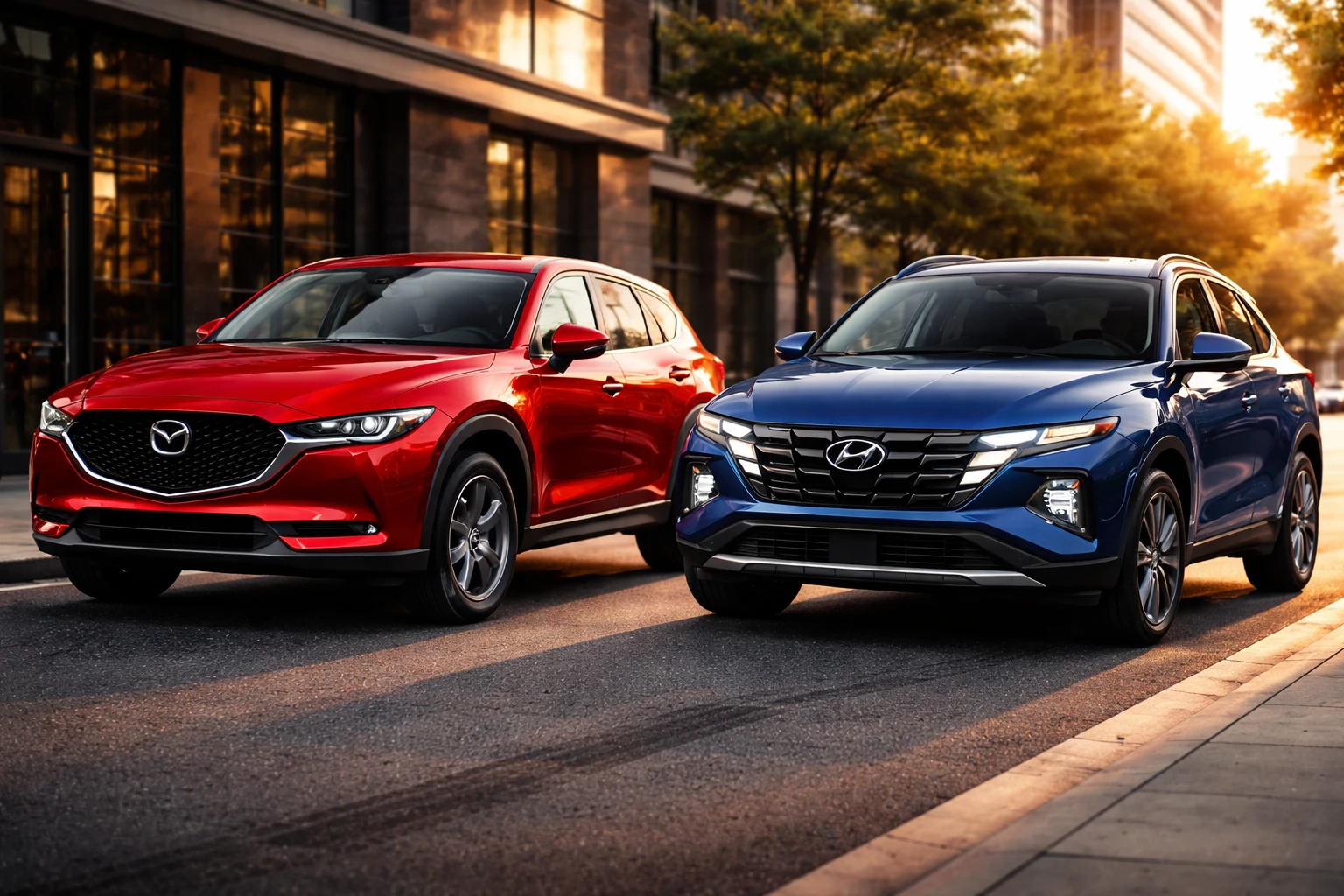
Overview of Mazda CX-5 vs Hyundai Tucson
Both SUVs compete in the compact crossover class alongside the Toyota RAV4 and Honda CR-V.
But their philosophies are different.
Mazda CX-5 positioning
The Mazda CX-5 focuses on:
- Engaging steering feel
- Available turbocharged performance
- Upscale interior materials
- Standard all-wheel drive (in many markets)
Mazda has long marketed the CX-5 as the “driver’s SUV.” The brand emphasizes chassis tuning and interior craftsmanship.
Hyundai Tucson positioning
The Hyundai Tucson focuses on:
- Hybrid and plug-in hybrid options
- Larger cargo capacity
- Bold exterior styling
- Long warranty coverage
Hyundai positions the Tucson as practical, tech-forward, and value-oriented.
So when comparing Mazda CX-5 vs Hyundai Tucson, you’re really deciding between two philosophies.
Performance and powertrains
Performance is where the Mazda CX-5 vs Hyundai Tucson debate becomes interesting.
Mazda CX-5 engine options
The current CX-5 offers:
- 2.5L naturally aspirated engine: 187 horsepower
- 2.5L turbocharged engine: up to 256 horsepower (with premium fuel)
- 6-speed automatic transmission
Independent testing shows the turbo CX-5 reaches 0–60 mph in approximately 6.2 seconds (varies by test conditions). That is quick for this class.
The base engine feels smooth but not aggressive. The turbo version transforms the SUV into one of the quickest in its segment.
Hyundai Tucson engine options
The Tucson lineup includes:
- 2.5L naturally aspirated engine: 187 horsepower
- Hybrid: 227 combined horsepower
- Plug-in hybrid: 261 combined horsepower
The base gas Tucson reaches 0–60 mph in about 8.8 seconds.
The hybrid version feels stronger off the line due to electric torque.
Turbo vs hybrid: what actually matters?
This is the core of the Mazda CX-5 vs Hyundai Tucson debate.
Ask yourself:
- Do you enjoy responsive acceleration?
- Or do you prioritize fuel savings?
The turbo CX-5 offers stronger highway passing power.
The Tucson hybrid offers better fuel economy and smoother city driving.
In daily commuting, most drivers won’t use full turbo power often. But you will notice fuel savings every week.
Fuel economy comparison
Fuel efficiency is where the numbers begin to separate clearly in Mazda CX-5 vs Hyundai Tucson.
Gas vs gas
Estimated EPA ratings (approximate):
- CX-5 2.5L: around 24–26 mpg combined
- Tucson 2.5L: around 26 mpg combined
The difference is small in real-world driving.
Hybrid advantage
Tucson Hybrid:
- Around 37–38 mpg combined
Plug-in Hybrid:
- 30+ miles electric-only range
According to EPA data (fueleconomy.gov), hybrid compact SUVs can save hundreds of dollars annually in fuel depending on mileage.
Over 5 years at 15,000 miles per year:
- Gas CX-5: approximately 2,885 gallons consumed
- Tucson Hybrid: approximately 1,973 gallons consumed
That’s nearly 900 gallons difference.
If fuel averages $3.50 per gallon, that’s over $3,000 in fuel savings.
For many buyers, that changes the outcome of Mazda CX-5 vs Hyundai Tucson.
Interior quality and comfort
Numbers don’t tell the full story. Cabin experience matters.
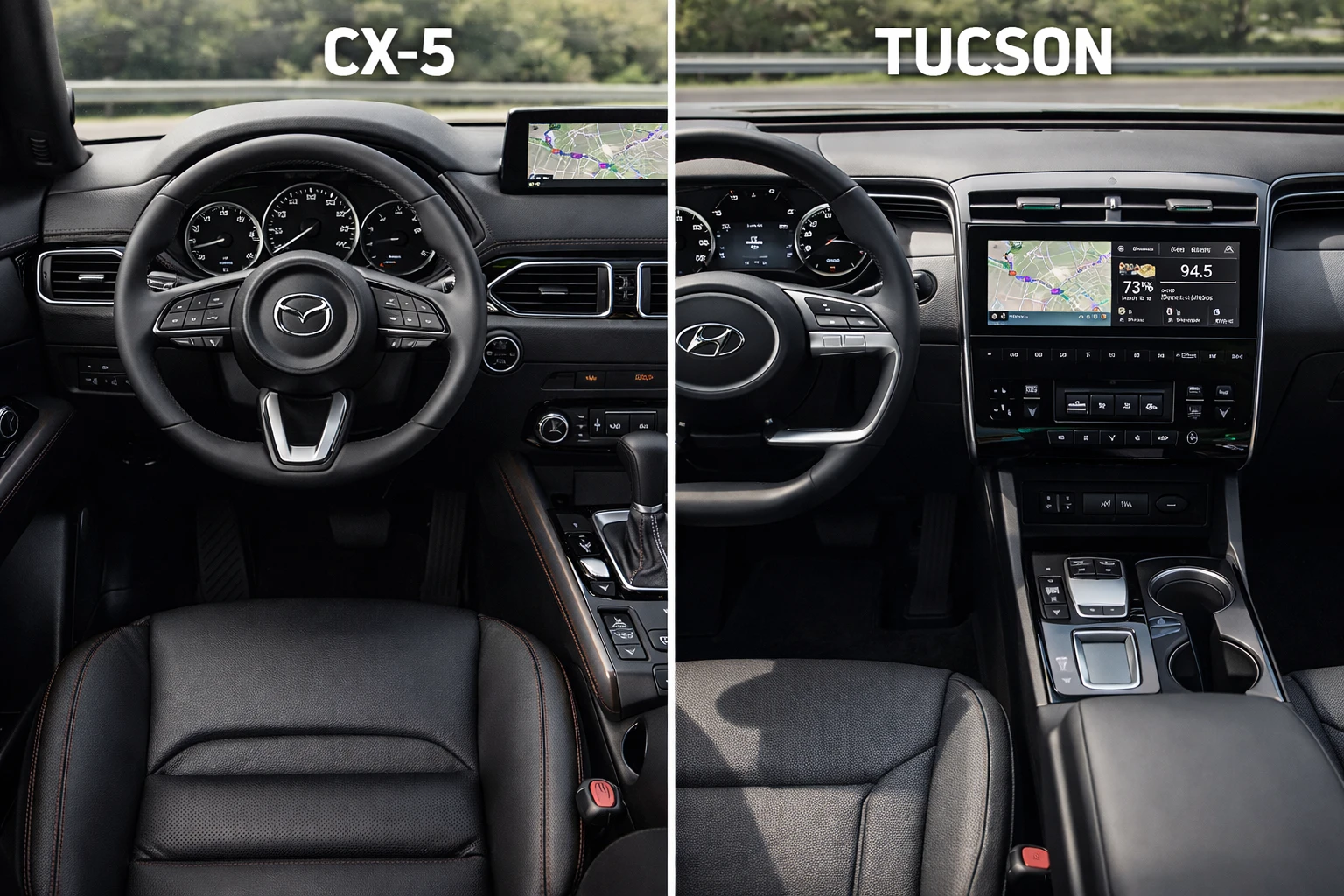
Mazda CX-5 interior feel
The CX-5 consistently receives praise for:
- Soft-touch materials
- Clean dashboard layout
- Supportive seats
- Traditional control layout
Upper trims feel near-luxury. Some reviewers compare its fit and finish to entry-level German brands.
Noise isolation is strong. Highway wind noise is well controlled.
Hyundai Tucson interior feel
The Tucson cabin emphasizes:
- Larger digital displays
- Modern, minimalist design
- Touch-sensitive controls
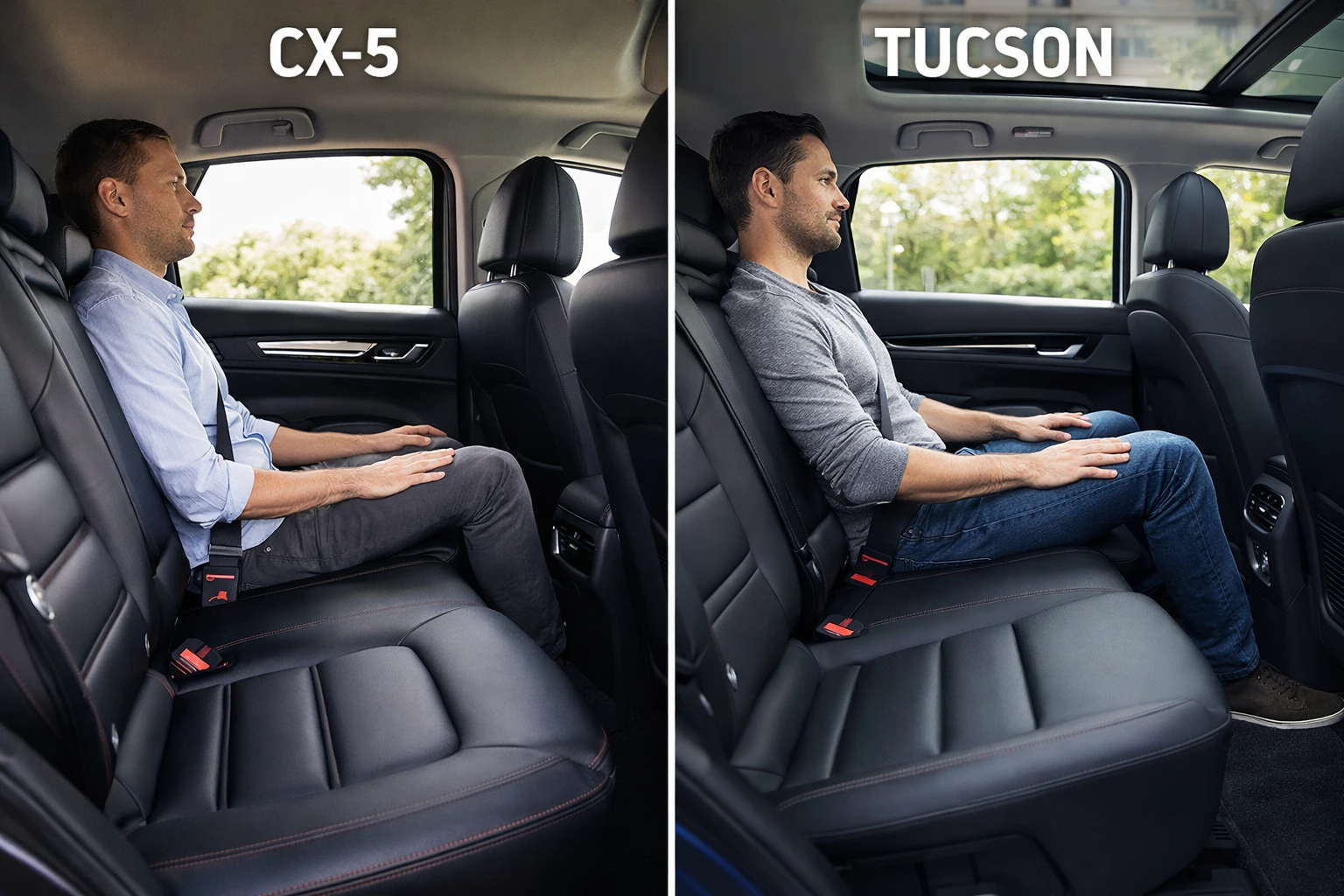
- More rear-seat legroom
It feels futuristic. But some trims use harder plastics than the CX-5.
In the Mazda CX-5 vs Hyundai Tucson comparison, the CX-5 often wins for material quality. The Tucson wins for space and screen size.
Cargo space and practicality
If you carry strollers, sports gear, or luggage, space matters.
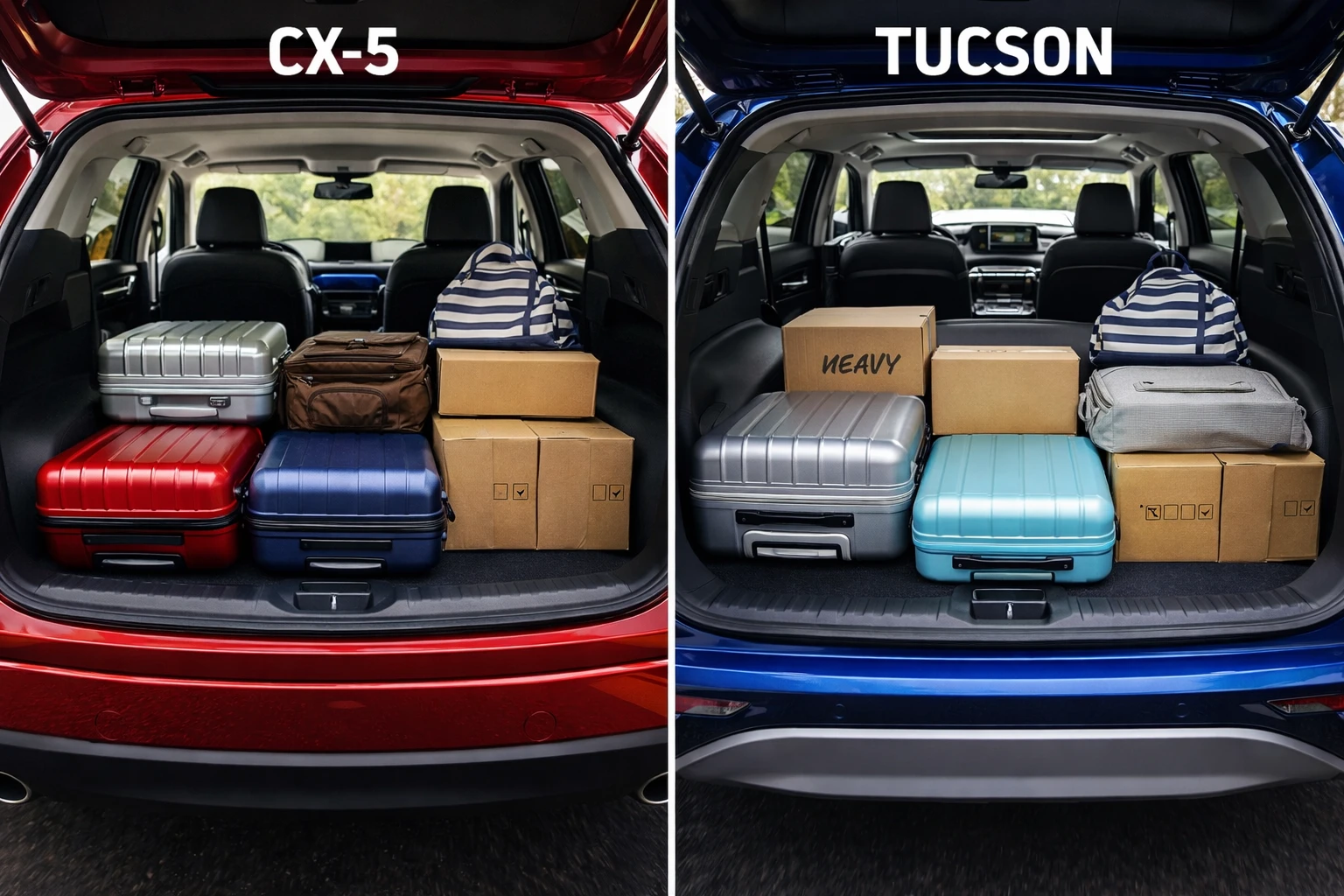
Cargo capacity
Approximate seats-up capacity:
- CX-5: around 30 cubic feet
- Tucson: around 38–39 cubic feet
Seats folded:
- CX-5: around 59 cubic feet
- Tucson: around 74 cubic feet
That’s a meaningful difference.
If you regularly transport large items, the Tucson is more practical.
Rear seat space
The Tucson offers slightly more rear legroom. Taller passengers notice this on longer trips.
In pure space metrics, the Tucson leads in the Mazda CX-5 vs Hyundai Tucson matchup.
Safety and driver assistance
Both SUVs offer advanced safety features.
Standard features typically include:
- Forward collision warning
- Automatic emergency braking
- Lane keeping assist
- Blind spot monitoring
Safety ratings from organizations like the Insurance Institute for Highway Safety (IIHS) often place both vehicles near the top of the class, depending on trim and headlights.
The safety gap in Mazda CX-5 vs Hyundai Tucson is minimal.
Warranty and ownership value
This is one area where the numbers clearly favor Hyundai.
Warranty coverage
Hyundai offers:
- 5-year / 60,000-mile basic warranty
- 10-year / 100,000-mile powertrain warranty
Mazda offers:
- 3-year / 36,000-mile basic warranty
- 5-year / 60,000-mile powertrain warranty
According to Hyundai’s official warranty documentation, this is one of the longest in the industry.
For buyers planning long-term ownership, this heavily influences the Mazda CX-5 vs Hyundai Tucson decision.
Real-world ownership scenario
Let’s imagine two buyers:
Buyer A drives 12,000 miles per year and keeps the vehicle 6 years.
Buyer B drives 18,000 miles per year and keeps it 5 years.
For Buyer B, fuel savings from the Tucson hybrid may exceed $3,500 over ownership.
For Buyer A, the premium interior and turbo performance of the CX-5 may deliver more daily satisfaction.
This is why context matters in Mazda CX-5 vs Hyundai Tucson — not just specs.
Driving experience comparison
Driving feel is subjective. But patterns emerge in reviews.
Mazda CX-5 driving feel
- Sharper steering response
- Firm but controlled suspension
- Strong turbo acceleration
It feels athletic for a compact SUV.
Hyundai Tucson driving feel
- Softer suspension
- Smooth hybrid transitions
- Less engaging steering
It prioritizes comfort and efficiency.
If you enjoy back-road driving, the CX-5 often feels more satisfying.
If you prefer relaxed commuting, the Tucson hybrid excels.
Cost of ownership considerations
When analyzing Mazda CX-5 vs Hyundai Tucson, total cost includes:
- Purchase price
- Fuel
- Insurance
- Maintenance
- Depreciation
Ownership cost studies from sources like Kelley Blue Book suggest Hyundai models often have competitive 5-year cost projections due to warranty coverage and fuel savings.
Resale values vary by trim and market demand.
Hybrid demand is rising in 2026, which may favor Tucson resale value.
At this stage, the comparison between Mazda CX-5 vs Hyundai Tucson comes down to what you prioritize: driving feel or efficiency, interior refinement or maximum cargo, turbo power or hybrid savings.
In the next section, we’ll dive deeper into long-term reliability trends, future model updates, resale value projections, and final decision guidance tailored to different buyer profiles.
Reliability trends and long-term durability
When people search Mazda CX-5 vs Hyundai Tucson, reliability is often the deciding factor.
Both brands have improved significantly over the past decade. But there are subtle differences worth understanding.
Mazda reliability track record
Mazda has built a strong reputation for mechanical simplicity and solid engine durability. The naturally aspirated 2.5L engine in the CX-5 has been used for years with minimal widespread issues.
Independent reliability tracking organizations such as Consumer Reports frequently rate Mazda above industry average in predicted reliability.
Turbocharged engines, while powerful, can introduce slightly higher long-term complexity. However, there is no widespread pattern of turbo failure in recent CX-5 models based on publicly available service bulletins.
If you prefer simpler engineering, the base CX-5 may feel like the safer long-term bet in the Mazda CX-5 vs Hyundai Tucson conversation.
Hyundai reliability track record
Hyundai has made major improvements in build quality and long-term durability.
The Tucson’s hybrid system uses a 1.6L turbocharged engine paired with electric assistance. Hybrid systems from Hyundai have generally shown strong reliability in recent model years.
The major advantage remains warranty coverage. Even if issues occur, Hyundai’s 10-year powertrain warranty provides extended protection.
For buyers who want long coverage peace of mind, the Tucson often leads in Mazda CX-5 vs Hyundai Tucson.
Depreciation and resale value
Depreciation is often overlooked in SUV comparisons. But it matters.
Compact SUVs tend to retain value well. However, trends are shifting.
Current resale outlook
Gas-only SUVs are stable, but hybrid demand is increasing in 2026.
Because the Tucson offers hybrid and plug-in hybrid options, market demand may favor it in urban areas with rising fuel costs.
Mazda models traditionally retain strong resale due to brand reliability perception and premium interior appeal.
In the Mazda CX-5 vs Hyundai Tucson resale comparison, the hybrid Tucson may have an edge in high-mileage ownership scenarios.
Technology and infotainment evolution
Technology expectations have changed dramatically in the past five years.
Mazda CX-5 tech experience
Earlier CX-5 models used smaller displays and a rotary controller. Newer versions feature larger touchscreens and improved smartphone integration.
The system is straightforward and less distracting. Some drivers prefer physical knobs over fully digital layouts.
Hyundai Tucson tech experience
The Tucson uses larger digital clusters and wide touchscreen layouts. Higher trims include advanced connectivity features and digital driver displays.
Over-the-air update capability is increasingly important for modern vehicles, and Hyundai has expanded software integration significantly.
For tech-focused buyers, the Tucson feels more futuristic in the Mazda CX-5 vs Hyundai Tucson debate.
Upcoming model updates
Future developments may change how we view Mazda CX-5 vs Hyundai Tucson.
Mazda CX-5 future direction
Mazda has announced plans for hybrid integration in upcoming model cycles. This signals a shift toward improved fuel efficiency while maintaining driving dynamics.
Interior space improvements are also expected in future redesigns.
If Mazda successfully combines hybrid efficiency with its driving character, the competitive balance may shift.
Hyundai Tucson future direction
Hyundai continues investing heavily in electrification.
The Tucson lineup is expected to maintain hybrid and plug-in hybrid options, refining efficiency and digital integration.
Hyundai’s rapid redesign cycle suggests continued aggressive competition in this segment.
Case study: two ownership profiles
Let’s look at real-world buyer types to clarify the Mazda CX-5 vs Hyundai Tucson decision.
Case 1: Daily commuter, 40-mile round trip
- Drives 5 days per week
- 20,000 miles annually
- Keeps vehicle 5 years
Fuel savings from the Tucson Hybrid could exceed $4,000 over 5 years.
For this buyer, the Tucson makes financial sense.
Case 2: Moderate driver, values driving feel
- Drives 10,000 miles annually
- Enjoys weekend road trips
- Keeps vehicle 6–7 years
Fuel savings are less dramatic.
Here, the turbocharged CX-5 may deliver more daily satisfaction without major cost disadvantage.
Context defines the outcome in Mazda CX-5 vs Hyundai Tucson.
Who should buy the Mazda CX-5?
Choose the CX-5 if:
- You prioritize driving engagement
- You prefer a refined, upscale cabin
- You value traditional controls over touch-heavy layouts
- You want strong turbo acceleration
- You drive moderate annual mileage
In short, if emotion and feel matter more than maximum space, the CX-5 shines in Mazda CX-5 vs Hyundai Tucson.
Who should buy the Hyundai Tucson?
Choose the Tucson if:
- You drive high annual mileage
- You want hybrid fuel efficiency
- You need maximum cargo space
- You prioritize long warranty coverage
- You prefer modern digital interfaces
If practicality and savings lead your priorities, Tucson leads in Mazda CX-5 vs Hyundai Tucson.
Frequently asked questions
Is the Mazda CX-5 more reliable than the Hyundai Tucson?
Both models show strong reliability in recent years. Mazda benefits from mechanical simplicity, while Hyundai provides longer warranty coverage. Long-term ownership confidence depends on whether you value simplicity or warranty protection more.
Which SUV has better fuel economy?
The Tucson Hybrid clearly outperforms the CX-5 in fuel efficiency. Gas-only versions are similar, but hybrid variants give Tucson the overall advantage in the Mazda CX-5 vs Hyundai Tucson comparison.
Is the Tucson hybrid better than the CX-5 turbo?
It depends on priorities. The Tucson Hybrid saves fuel and offers strong torque delivery. The CX-5 turbo offers quicker acceleration and more engaging handling. Efficiency vs performance defines this choice.
Final verdict on Mazda CX-5 vs Hyundai Tucson
After analyzing performance data, fuel efficiency numbers, cargo space measurements, warranty coverage, resale trends, and real-world driving impressions, one truth becomes clear:
There is no universal winner in Mazda CX-5 vs Hyundai Tucson.
The CX-5 excels in:
- Driving feel
- Interior refinement
- Turbocharged performance
The Tucson excels in:
- Hybrid efficiency
- Cargo capacity
- Warranty coverage
- Technology-forward design
If I were choosing based purely on driving enjoyment, I would lean toward the CX-5 turbo.
If I were prioritizing long-term fuel savings and space for a growing family, I would choose the Tucson hybrid.
Your lifestyle determines the right answer in Mazda CX-5 vs Hyundai Tucson.
I am an automotive researcher and SUV comparison specialist with years of experience analyzing manufacturer specifications, ownership cost data, and real-world vehicle testing reports. My work focuses on helping buyers make informed, practical decisions based on measurable data and verified industry sources.
Disclaimer
All specifications, fuel economy estimates, and warranty details are based on publicly available manufacturer data and independent automotive research at the time of writing. Actual ownership experience may vary based on driving habits, maintenance practices, regional pricing, and model year updates. Always verify details with official dealership sources before purchasing.