
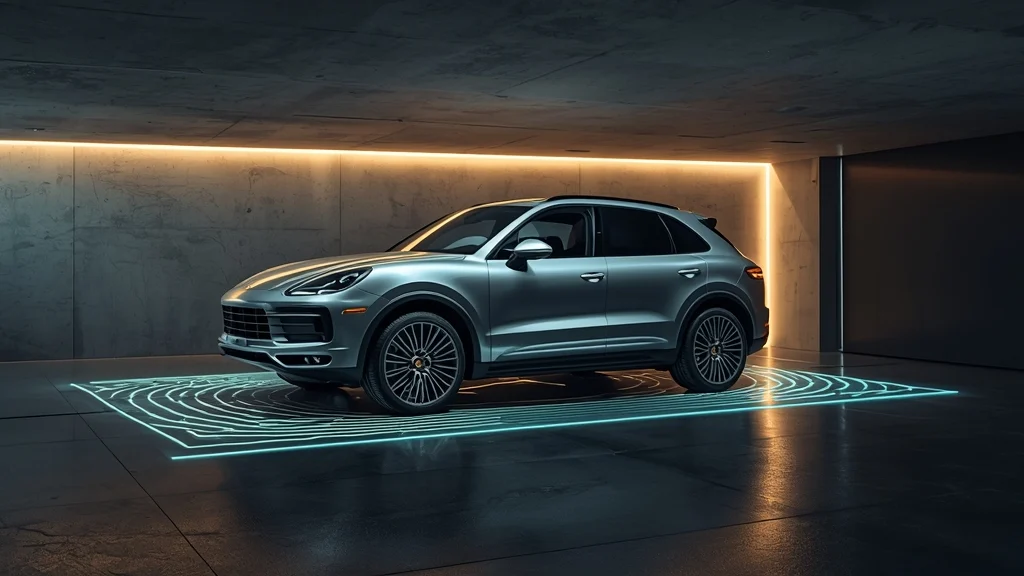
Porsche unveils a wireless charging system for the Cayenne Electric. Is the $6,400 price tag worth the luxury? Explore the tech and costs here.
In the quest to make home charging as seamless as a trip to the gas station, automotive manufacturers are reimagining the entire refueling process. Leading this charge is Porsche, which has officially unveiled a sophisticated inductive charging system designed specifically for the new Cayenne Electric.
For owners who want to ditch the cables and enjoy a truly hands-free experience, Porsche is offering a wireless charging option that transforms the way the luxury SUV powers up at home.
How Porsche’s Inductive Charging Works
At the center of this system is a substantial 50 kg (approx. 110 lbs) charging pad. Once plugged into a power outlet, the pad utilizes a large transmitting coil to convert AC voltage from the grid into DC power. When the Cayenne Electric parks directly over the pad, a secondary coil located beneath the SUV begins to receive the energy via induction.
According to Porsche, the system supports a power output of up to 11 kW. This is a significant detail; as noted by Jason Fenske of Engineering Explained, Porsche’s standard mobile chargers in the US max out at 9.6 kW. This means the wireless option isn’t just more convenient—it’s actually a faster home charging solution for US owners.
Precision Parking and High Efficiency
To ensure the vehicle is perfectly aligned for maximum energy transfer, Porsche has integrated specialized software into the Cayenne Electric’s Surround View parking assistance. The system displays the position of the receiver near the front axle, using a green circle to guide the driver exactly over the charging pad.
One common criticism of wireless charging is energy loss. However, Porsche engineers claim their system achieves an efficiency of 89% to 92% in real-world conditions. This comfortably exceeds the current industry standard minimum of 85%. Interestingly, Porsche noted that Level 1 wired charging on the Cayenne Electric only hits about 60% efficiency, making the wireless pad a surprisingly efficient leap forward compared to standard household outlets.
Safety First: Weatherproof and Smart
Porsche has ensured that the high-tech pad can handle the elements. The system is completely waterproof and equipped with advanced sensors to detect foreign objects. If any metallic object is detected between the pad and the vehicle, the system immediately halts charging to prevent overheating or hazards.
The Price of Luxury: A Steep Investment
While the technology is impressive, the cost is where many potential buyers may hesitate. The system carries a heavy premium:
- In the UK: The total system is expected to cost approximately £6,750 (roughly $9,125), with the charging pad alone accounting for £4,750 ($6,421).
- In the US: The charging pad is priced at approximately $6,500 (before tax), while the integrated hardware required inside the Cayenne EV adds another $1,650 to the bill.
Is it a sound investment?
From a long-term energy perspective, the cost of electricity doesn’t vary wildly. Analysis by Fenske suggests that over 200,000 miles, the difference in electricity costs between wireless charging and a standard Level 2 wired system is only about $1,000.
However, based on the average US driving distance of 13,000 miles per year, it would take nearly 15 years to realize that energy difference. This leaves the massive upfront hardware cost as the primary barrier. For most, the $6,400+ price tag is a payment for pure convenience and the prestige of cutting-edge tech, rather than economic efficiency.