
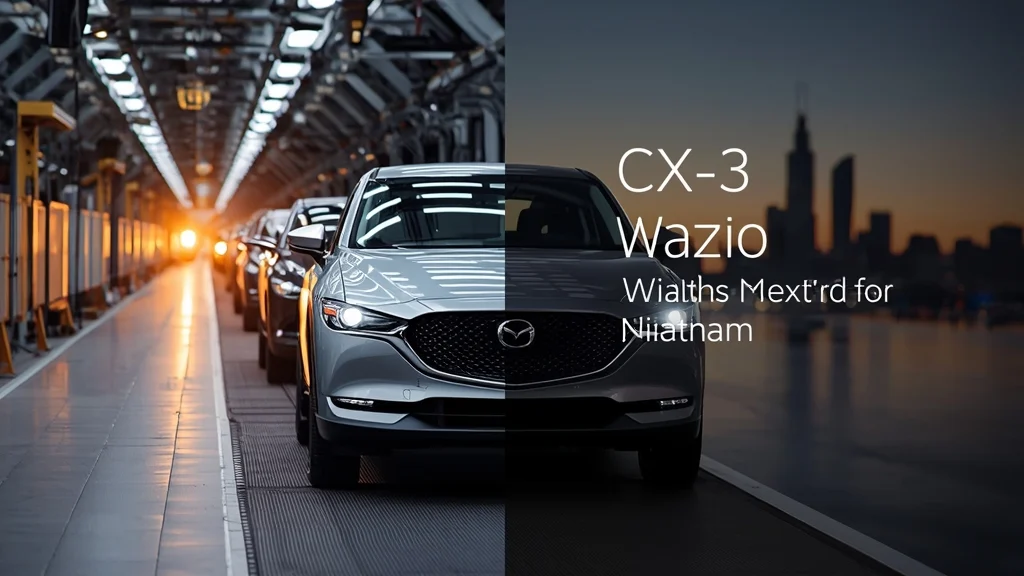
Mazda confirms the CX-3 will stop production in Japan, leaving Vietnamese buyers uncertain. Find out the timeline, alternatives, and future plans. Explore now!
After more than a decade on global showrooms, Mazda’s compact CUV — the CX-3 — is entering its final chapter. Carscoops reports that Mazda has officially ended production of the CX-3 at its Japanese plant this month, signalling that the model could disappear from other markets as the automaker shifts resources to newer vehicles.
Brief history of the CX-3
Launched in 2015, the CX-3 was one of the smallest and most recognizable sub‑compact crossovers in Mazda’s lineup. For ten years it received modest updates, but it gradually fell behind more modern rivals such as the CX-5, CX-50, CX-60 and CX-80, which boast advanced safety, infotainment and power‑train technologies.
Production stop in Japan
According to Mazda’s Japanese website, domestic production of the CX-3 ceased this month. The announcement did not clarify whether exports will continue, but Carscoops notes that the cessation in Japan often precedes a global phase‑out. Some assembly plants in Thailand remain operational, yet the trend points toward an eventual worldwide discontinuation.
Effect on other markets
The United States already stopped receiving the CX-3 in 2021 when Mazda introduced the CX-30 as a more contemporary replacement. The CX-30 quickly gained acceptance across multiple regions, reducing demand for the older CX-3 platform. Similar patterns are emerging in Europe and other Asian markets.
What does this mean for Vietnam?
In Vietnam, Thaco Auto, Mazda’s local partner, has not issued a comment on the production halt. While the model is still sold locally, future availability may depend on how quickly Mazda redirects supply from Thailand or introduces a successor.
Upcoming replacements
Mazda appears to be preparing a next‑generation sub‑compact crossover, rumored to be called the CX-20. Sketches unveiled at a recent event in Thailand showcase a youthful design language, sharper lines and a more spacious cabin. The CX-20 would directly succeed the CX-3 and aim to compete with newcomers such as the Toyota Yaris Cross and Mitsubishi Xforce.
Broader product strategy
The CX-3’s retirement aligns with Mazda’s broader strategy to focus on higher‑tech CUVs and SUVs that target fast‑growing segments. Alongside the CX-3, the long‑standing Mazda2 hatchback is also slated for discontinuation by 2026, marking the end of two of Mazda’s longest‑running models.
What buyers should consider now
- Explore the Mazda CX-30 for a more up‑to‑date sub‑compact experience.
- Monitor Thaco’s announcements for possible stock of the existing CX-3 or early arrivals of the CX-20.
- Compare alternatives from other brands, such as the Toyota Yaris Cross, Mitsubishi Xforce, or Hyundai Kona.
While the CX-3’s decade‑long run is drawing to a close, Mazda’s upcoming models promise to keep the brand competitive in the global sub‑compact crossover market.