
Volkswagen is losing its grip on China as young buyers swap legacy luxury for tech-forward EVs. Can VW regain its crown? Explore the full story.
For decades, Volkswagen reigned supreme in China, dominating the roads with a reputation for German engineering and reliability. However, the tide has turned. As the world’s largest automotive market pivots toward a digital-first, electric future, the German giant is finding itself viewed not as a symbol of status, but as a relic of the past.
The ‘Parents’ Brand’ Dilemma
In a candid admission, Robert Cisek, CEO of Volkswagen in China, told Reuters that the brand is facing a perception crisis among the next generation of drivers. “Perhaps some young customers view us as a brand for their parents,” Cisek noted.
For today’s Chinese youth, a car is no longer just a mode of transportation; it is a “smartphone on wheels.” While Volkswagen’s legacy is built on the internal combustion engine and “Made in Germany” precision, young consumers are gravitating toward domestic brands that offer cutting-edge software, sleek aesthetics, and aggressive pricing.
A Rapid Fall from Grace
The shift has been nothing short of seismic. After 25 years as the top automaker in China, Volkswagen was overtaken by the EV powerhouse BYD in 2024. By 2025, Geely pushed them further down to third place.
Volkswagen isn’t alone in this struggle. Other German luxury staples, including Audi, BMW, and Mercedes-Benz, have also seen sharp declines. According to S&P Global Mobility, total sales for German automakers in China dropped by 25% over five years, falling to 3.9 million vehicles by 2025.
Legacy vs. Innovation: The Cultural Clash
The irony of Volkswagen’s decline is that its greatest strength—its heritage—has become a liability. Yale Zhang, an executive at Shanghai-based Automotive Foresight, suggests that German brands are being “killed” by their own history.
“You cannot truly rely on chrome strips, Napa leather seats, and a ‘hundred-year’ history to convince today’s consumers,” Zhang explained. The luxury cues that once defined prestige are now seen as outdated by digital natives who value connectivity and autonomous driving over traditional craftsmanship.
The Road to Recovery: VW’s Bold Pivot
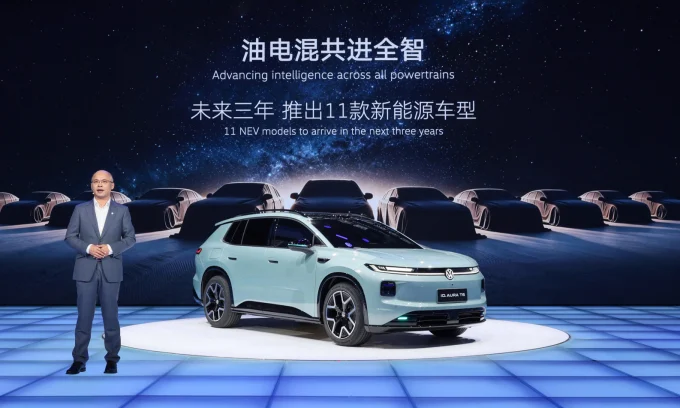
Recognizing that they are playing catch-up in a market where over 25% of new cars are pure electric, Volkswagen is launching a massive counter-offensive. Under the leadership of CEO Oliver Blume, the company plans to introduce 20 new energy models in China this year.
This strategy includes a diverse mix of:
- Pure Electric Vehicles (BEVs) developed in collaboration with Chinese partners like FAW and Xpeng.
- Plug-in Hybrids (PHEVs) to bridge the gap for cautious buyers.
- Range-Extended EVs that utilize small combustion engines to eliminate range anxiety.
One of the most striking changes is the rebranding of Audi for the Chinese market. In a move to distance itself from old perceptions, a new AUDI model (developed with SAIC) has swapped the iconic four rings for a bold, capitalized text logo.
Lessons for the Global Stage
Volkswagen’s struggle in China serves as a warning to the global automotive industry: brand loyalty is not permanent. To survive, legacy automakers must be willing to dismantle their own traditions to embrace the speed of software-driven innovation.
While the “Made in Germany” label still commands respect for safety and quality, the battle for the future of mobility is being won by those who can innovate the fastest, not those who have the longest history.