

Discover how the Wankel rotary engine, once a Mazda hallmark, is being revived by a Chinese firm for drone & VTOL applications. Learn more!
Chinese automotive manufacturers are not only redefining the electric vehicle landscape, but one company is also revisiting a fascinating piece of automotive history: the Wankel rotary engine. Originally designed by German engineer Felix Wankel and famously refined by Mazda [Mazda], the Wankel engine is now being reimagined by a subsidiary of the Changan automotive group. However, this time, its focus isn’t the road, but the skies.
From Cars to Drones: A New Purpose for the Wankel
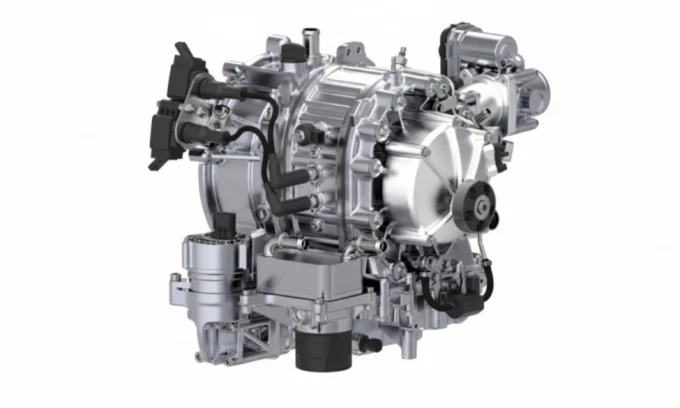
The project originates from Harbin Dongan Auto Engine, a company that has developed a single-rotor engine prototype specifically for low-altitude flight. This includes unmanned aerial vehicles (drones), as well as vertical takeoff and landing (VTOL) aircraft – a rapidly growing sector in China.
Power and Performance Specifications
While the Dongan engine’s power output isn’t exceptionally high, it’s tailored for a very specific role. It can achieve speeds of 6,500 rpm and produce 53 kW, equivalent to approximately 71 horsepower.
Although the maximum speed isn’t groundbreaking, the engine features a cast aluminum housing and a diamond-like carbon (DLC) nano-composite coating to reduce friction, highlighting a focus on efficiency and durability for aerial applications. A twin-rotor version is also under development, projected to double the power output to 148 horsepower.
Key Advantages for Flight
The engine’s compact rotary design, impressive power-to-weight ratio, and smooth operation with minimal vibration are qualities that are far more critical in flight conditions than in everyday driving. These characteristics make it an ideal candidate for powering the next generation of aerial vehicles.
Partnerships and Future Development
Dongan is also researching rotary engines for medium- and high-altitude UAVs, including both naturally aspirated and turbocharged variants. Partners include Aridge, the aviation division of Xpeng, as well as industry giants like Huawei and DJI. Production of the single-rotor engine is anticipated to begin in 2027.
Mazda’s Wankel Journey: Past and Present
Mazda, after decades of pursuing this technology, ultimately ceased development of the Wankel design in 2012 due to increasingly stringent Euro 5 emissions regulations. However, the story didn’t end there.
In 2023, the Wankel engine made a comeback under the hood of the MX-30 R-EV, this time functioning as a range extender. In this configuration, the single-rotor engine produces 74 horsepower and has a displacement of 830cc – not a powerhouse, but sufficient to recharge the battery.
A High-Performance Future?
However, a high-performance Wankel engine may be on the horizon. In 2025, Mazda unveiled the bold Vision-X Coupe, equipped with a turbocharged Wankel engine, an electric motor, and a battery pack working together to generate a combined output of 503 horsepower. It remains a prototype, but serves as a reminder that Mazda hasn’t entirely abandoned the Wankel engine.
A Legacy of Innovation
Mazda acquired the rights to the Wankel engine in 1967 and successfully refined it, developing a commercially viable rotary engine with characteristics considered optimal at the time: compact yet powerful, high-revving, and durable, with an appealing sound and minimal vibration.
From that point forward, the rotary engine became inextricably linked with Mazda, representing a technical achievement that transformed the automotive industry and propelled Mazda onto the global automotive map.