Choosing between the Mazda CX-5 vs Toyota RAV4 is like trying to decide between a finely tailored suit and a high-performance North Face jacket. Both are exceptional, both serve a clear purpose, but the “feel” is worlds apart. If you are currently in the market for the best small SUV for families, you have undoubtedly crossed paths with these two titans. They dominate the sales charts and for good reason. In this compact SUV comparison, we are going to dive deep into the nitty-gritty details to help you decide which one belongs in your driveway. Whether you prioritize CX-5 vs RAV4 fuel economy or you are more interested in the CX-5 vs RAV4 driving experience, we have got you covered.
The Compact SUV Landscape: An Overview
The compact crossover segment is the most competitive space in the automotive world today. For decades, the sedan was king, but the versatility of the SUV has taken over. When we look at the Mazda CX-5 vs Toyota RAV4, we aren’t just looking at two cars; we are looking at two different philosophies of what a modern vehicle should be.
The Rise of the Compact SUV
Why has the compact SUV become the default choice for millions? It’s the “Goldilocks” effect. They aren’t as bulky and difficult to park as full-size SUVs, yet they offer a higher seating position and more utility than a standard hatchback or sedan. According to recent industry trends Toyota Newsroom, 2024, the RAV4 continues to be a global best-seller because it hits the sweet spot of reliability and utility.
Mazda CX-5: The Driver Choice
Mazda has always marched to the beat of its own drum. While other manufacturers focus on “bigger is better,” Mazda focuses on “better is better.” The CX-5 is often described as the “poor man’s Porsche” because of its incredible handling and premium feel compact SUV interior. It’s designed for the person who actually enjoys the act of driving, rather than just getting from point A to point B.
Toyota RAV4: The Practical Powerhouse
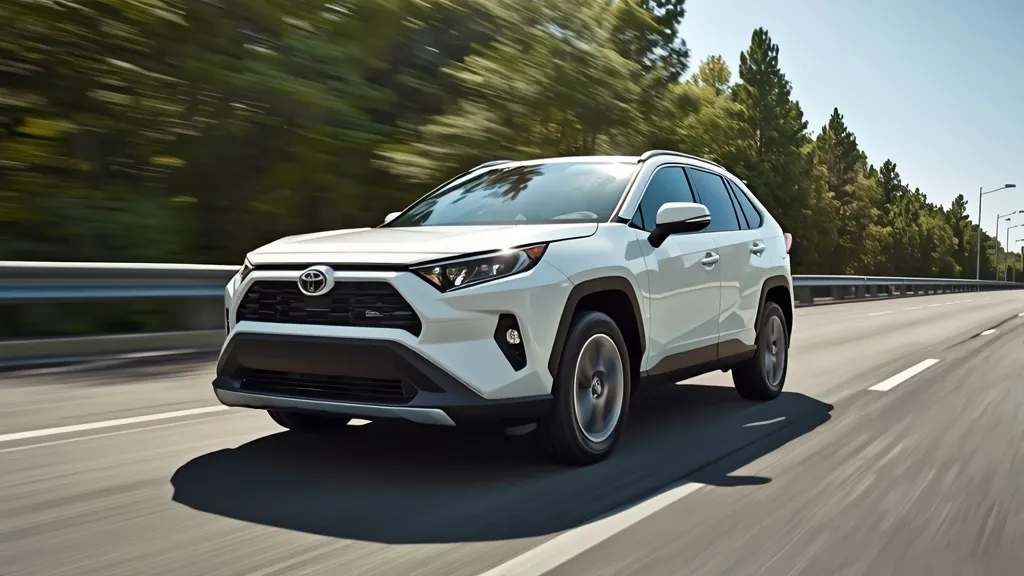
On the other side of the ring, we have the Toyota RAV4. It is the pragmatic choice. It’s the vehicle you buy when you want to know that ten years from now, it will still start every single morning without a fuss. It is a reliable compact SUV that focuses on space, efficiency, and a rugged aesthetic that says, “I’m ready for a weekend camping trip.”
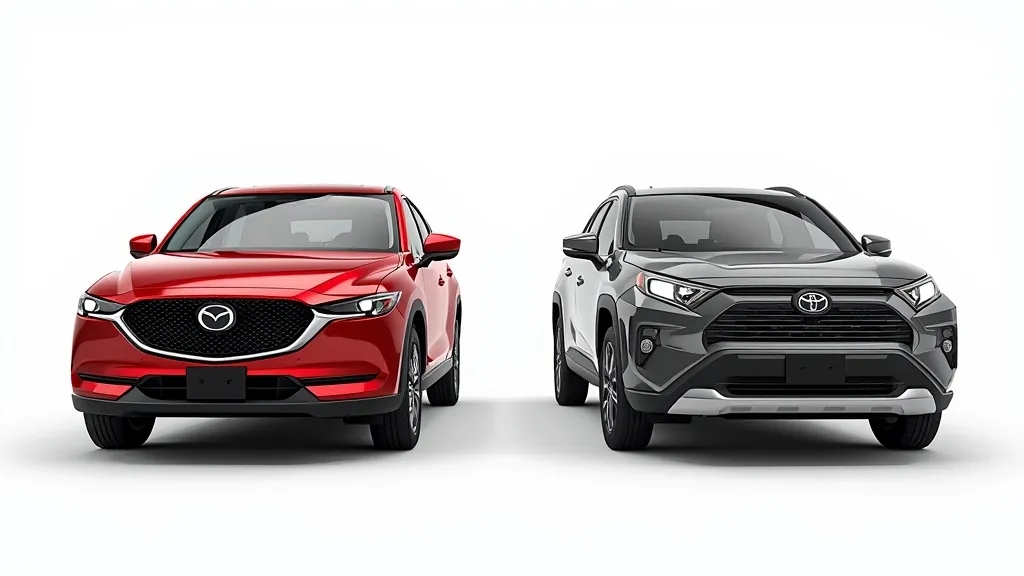
Exterior Design and Aesthetics
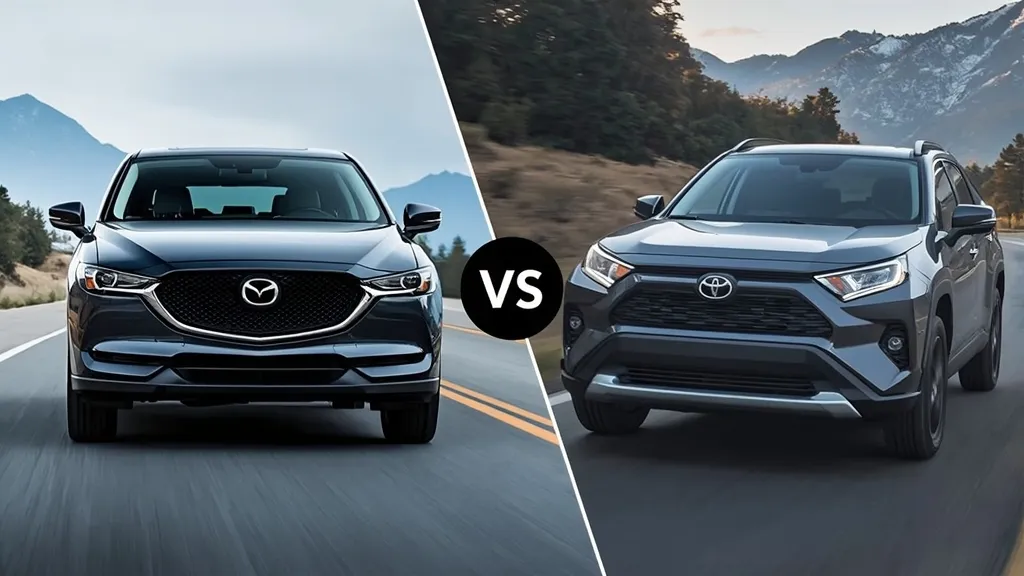
When you park a Mazda CX-5 vs Toyota RAV4 side-by-side, the visual contrast is striking. One is all about curves and light; the other is all about angles and presence.
Mazda CX-5: Sculpted Elegance
Mazda utilizes what they call “Kodo” design, which translates to “Soul of Motion.” The idea is to create a sense of movement even when the car is standing still.
Front Fascia and Grille
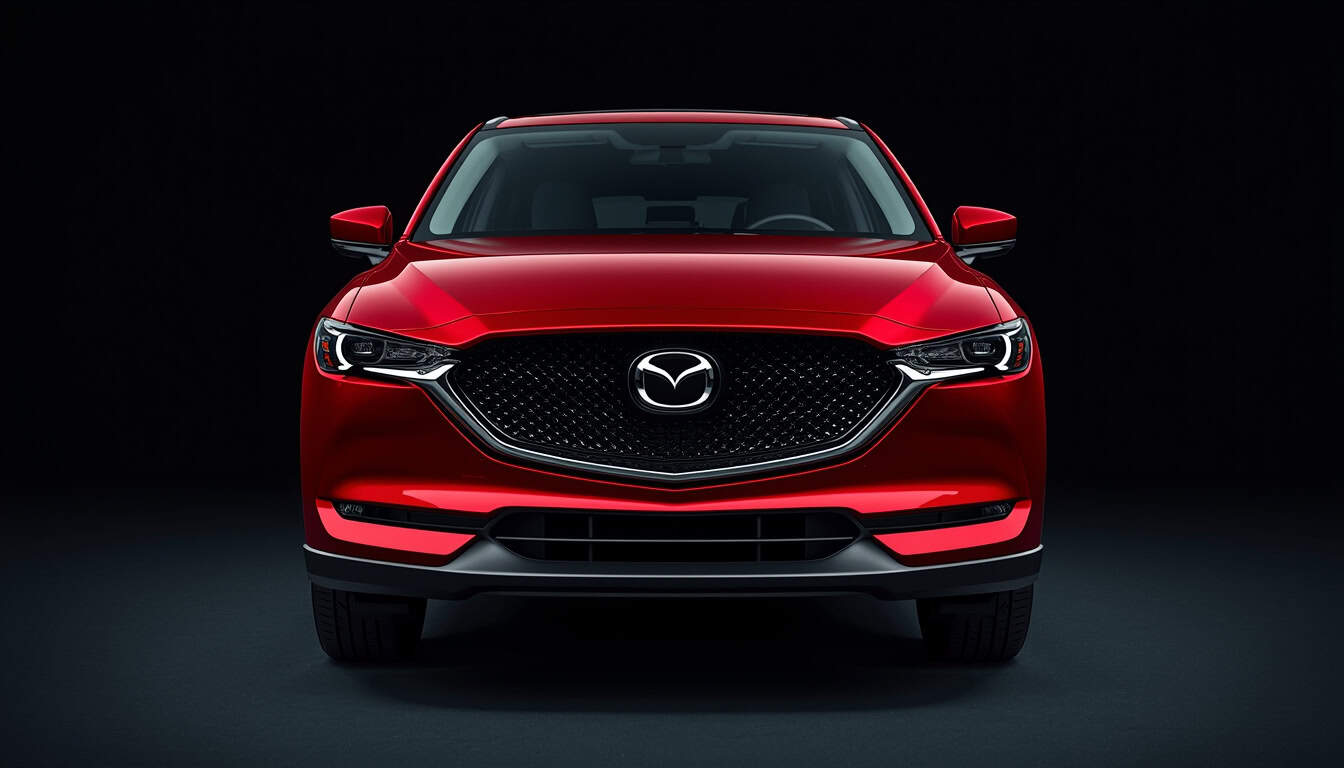
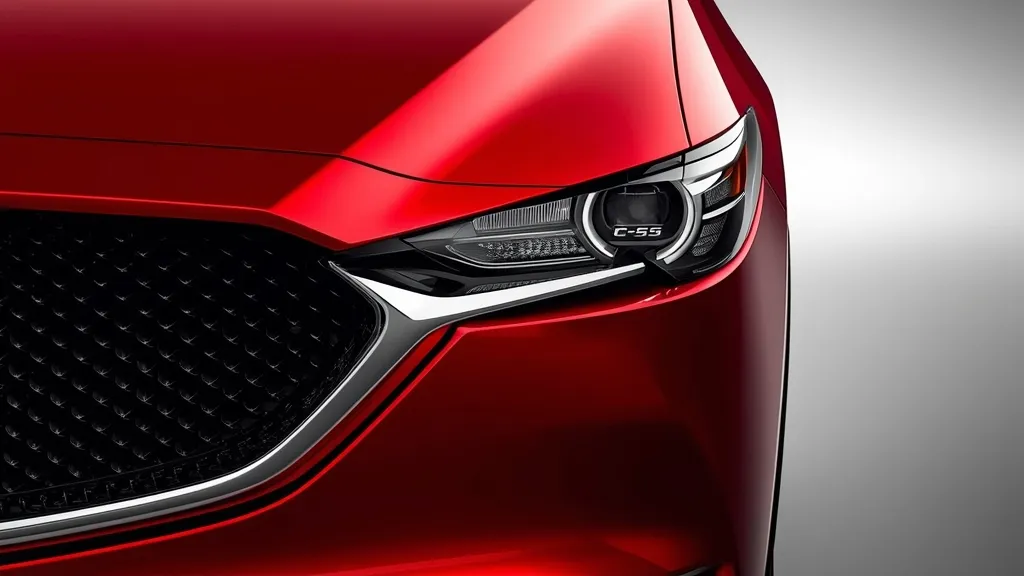
The CX-5 features a large, mesh-textured grille that is underlined by a signature chrome wing. The headlights are slim and aggressive, giving it a sophisticated, hawk-like gaze.
Lighting Signature
Mazda LED lighting isn’t just functional; it’s an art form. The way the light wraps around the housing adds to that premium feel compact SUV vibe that Mazda is famous for.
Side Profile and Wheel Designs
Unlike many SUVs that use heavy plastic cladding around the wheel wells, the higher trims of the CX-5 often have body-colored moldings. This makes the car look more like a high-end European luxury vehicle than a rugged off-roader.
Toyota RAV4: Rugged and Adventurous
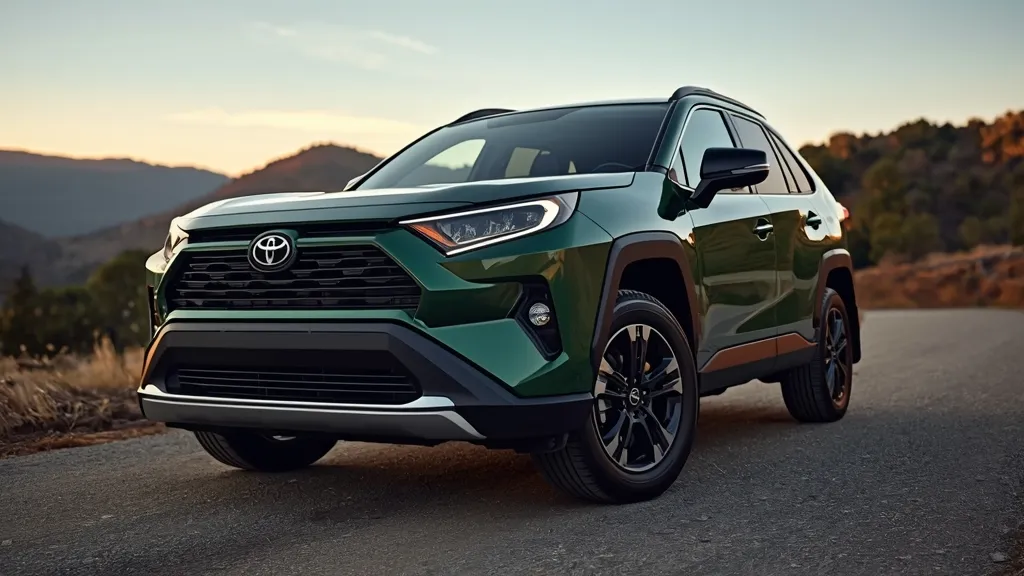
Toyota took a big risk with the current generation of the RAV4 by moving away from the “cute-ute” look and moving toward a mini-4Runner aesthetic.
Bold Front End and Distinctive Grille
The RAV4 has a much more vertical and blunt front end. Depending on the trim, you get different grille designs—the Adventure and TRD Off-Road trims look particularly mean with their hexagonal patterns.
LED Lighting Elements
The headlights on the RAV4 are more blocky and utilitarian. They sit higher on the body, contributing to that “tough” look that many buyers in this compact SUV comparison find appealing.
Chunky Cladding and Stance
The RAV4 leans into its SUV roots with prominent black plastic cladding. This isn’t just for looks; it protects the bodywork from rocks and debris if you actually take it off the pavement.
Interior Design Quality and Comfort
This is where the Mazda CX-5 vs RAV4 interior comparison gets really interesting. If you were to blindfold a passenger and put them in both cars, they might guess the Mazda costs $20,000 more than it actually does.
Mazda CX-5: A Premium Cabin Experience
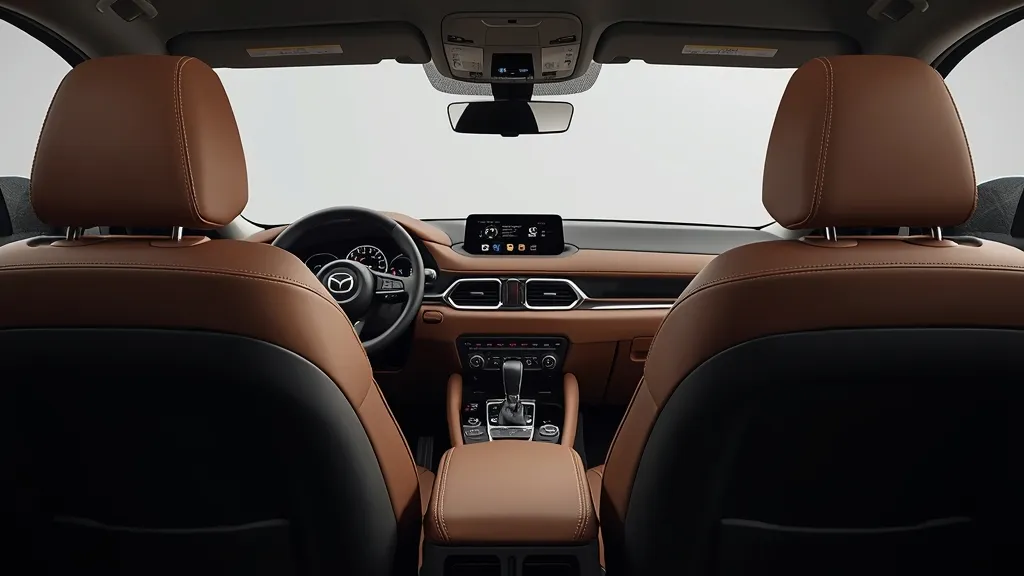
The moment you sit in a CX-5, you notice the materials. There is soft-touch leatherette or genuine Nappa leather everywhere your hands naturally land.
Material Quality and Touchpoints
The stitching is real, the metal accents are cold to the touch, and the buttons have a satisfying “click” that feels substantial. It truly provides a premium feel compact SUV experience.
Ergonomics and Layout
Mazda follows a philosophy called “Jinba Ittai,” which means “horse and rider as one.” Everything is centered around the driver. The pedals are perfectly aligned with your hips, and the steering wheel has a wide range of adjustments.
Seating Comfort
The seats in the CX-5 are firm but supportive. They are designed to keep your spine in its natural S-curve, which reduces fatigue on long road trips. However, some might find the rear seats a bit tighter compared to the RAV4.
Toyota RAV4: Functional and Durable
Toyota interior is built for life. It’s built for kids spilling juice boxes and dogs jumping in the back with muddy paws.
Material Choices and Durability
While there are soft-touch surfaces, you’ll find more hard plastics in the RAV4 than in the CX-5. However, Toyota uses a material called SofTex on higher trims, which is a synthetic leather that is incredibly easy to clean and very durable.
Intuitive Controls and Layout
The RAV4 features large, rubberized knobs for the climate control. This is a brilliant design choice because you can easily adjust the temperature even if you are wearing gloves. It’s a “function over form” approach that works perfectly for a reliable compact SUV.
Practical Storage and Cubbies
The RAV4 wins hands-down when it comes to interior storage. There’s a long shelf built into the dashboard for the passenger’s phone or sunglasses, and the center console bin is cavernous.
Technology and Infotainment System
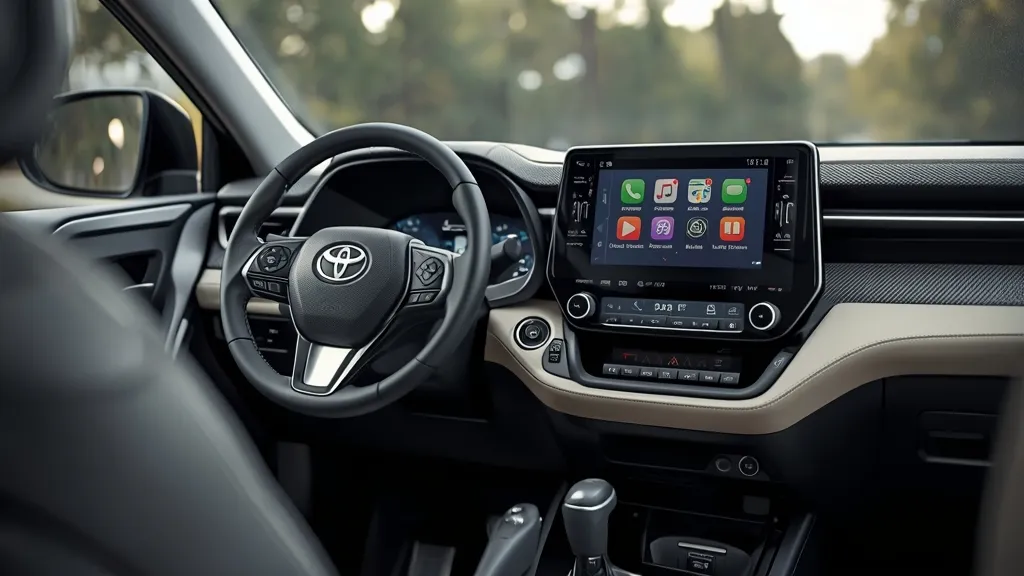
How we interact with our cars has changed, and the infotainment system compact SUV buyers expect today must be seamless.
Mazda CX-5: Driver-Focused Connectivity
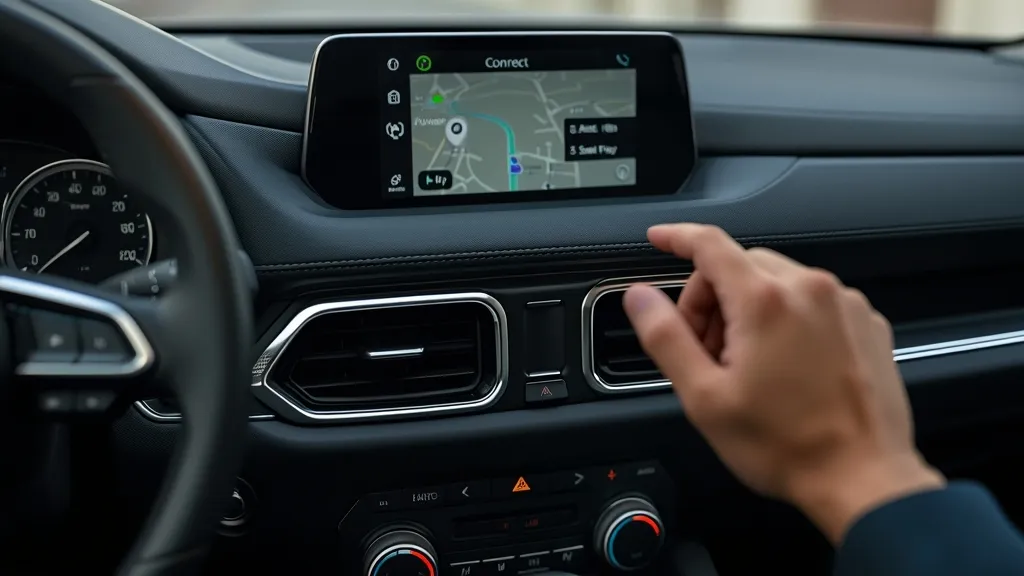
Mazda does things differently here. Most modern cars have giant touchscreens. Mazda, however, believes that reaching for a touchscreen while driving is a safety hazard.
Infotainment Screen Size and Interface
The CX-5 features a 10.25-inch display that is controlled primarily by a rotary knob on the center console. It feels very similar to the systems found in BMW or Audi. While it takes a week to get used to, many owners end up preferring it because you don’t have to take your eyes off the road.
Apple CarPlay and Android Auto Integration
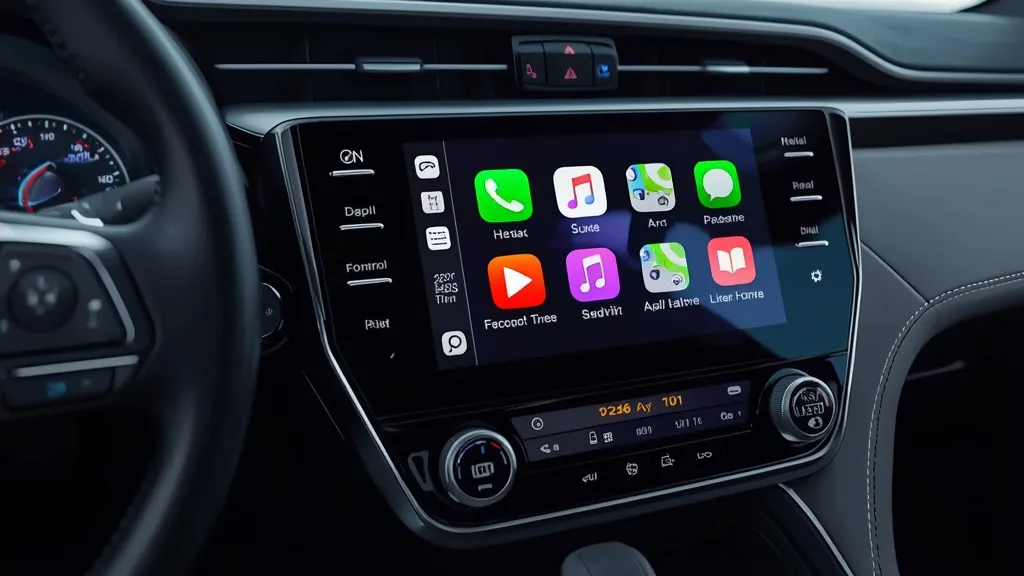
Both are standard. In newer models, they can be used wirelessly. Interestingly, Mazda does allow touchscreen functionality specifically for Apple CarPlay and Android Auto, acknowledging that these interfaces are designed for touch.
Toyota RAV4: User-Friendly and Feature-Rich
Toyota recently updated its infotainment system, and it is a massive leap forward from the older versions.
Infotainment Screen Size and Responsiveness
The RAV4 offers screens up to 10.5 inches. Unlike the Mazda, it is a full-time touchscreen. The software is snappy, the graphics are modern, and it supports over-the-air updates.
Toyota Connected Services
Toyota offers a robust suite of connected services, including a Wi-Fi hotspot and the ability to start your car or lock your doors from a smartphone app. For many, this makes it the best small SUV for families who need to stay connected.
Performance and Driving Dynamics
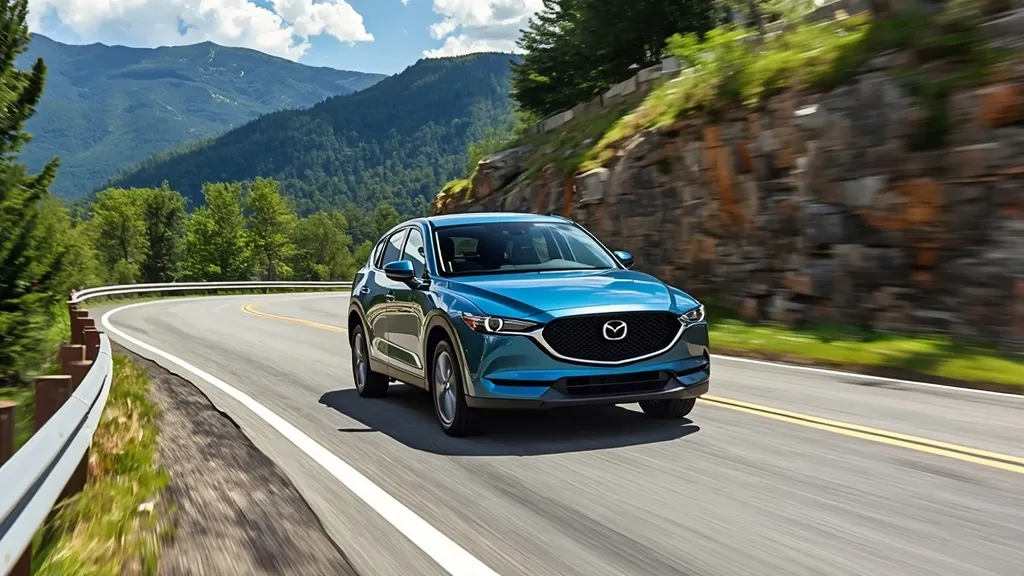
If you enjoy the “zoom-zoom” spirit, the CX-5 vs RAV4 driving experience will likely be the deciding factor for you.
Mazda CX-5: Engaging and Agile
The CX-5 doesn’t drive like an SUV; it drives like a tall sport sedan. It features “G-Vectoring Control Plus,” a fancy piece of software that subtly adjusts engine torque when you turn the wheel to shift weight and improve grip.
Engine Options and Horsepower
The base 2.5L engine is adequate, but the 2.5L Turbo is the star of the show. It delivers up to 250 horsepower and a massive 320 lb-ft of torque. When you hit the gas in a Turbo CX-5, it moves with a level of authority that the RAV4 can’t quite match.
Car-Like SUV Handling
The steering is heavy and precise. When you go around a corner, the body doesn’t lean excessively. It feels planted and confident, giving you that car-like SUV handling that enthusiasts crave.
Toyota RAV4: Competent and Composed
The RAV4 isn’t trying to be a sports car. It’s trying to be a comfortable cruiser, and it succeeds.
Standard Gasoline Engine Performance
The 203-horsepower naturally aspirated engine is reliable but can be a bit buzzy under hard acceleration. It’s perfectly fine for merging onto the highway, but it won’t get your heart racing.
AWD vs FWD SUV
While both offer Front-Wheel Drive, most buyers opt for All-Wheel Drive. Toyota offers three different AWD systems, including a sophisticated Dynamic Torque Vectoring system on the Trail and Limited trims that can disconnect the rear axle to save fuel when AWD isn’t needed.
Fuel Economy and Powertrains
This is the section where the Toyota RAV4 usually takes a victory lap. When discussing CX-5 vs RAV4 fuel economy, the difference in technology is significant.
Mazda CX-5: The Traditionalist
Mazda relies on high-compression gasoline engines. They are efficient for what they are, but they can’t compete with a hybrid.
- Standard 2.5L: Expect around 26-28 MPG combined.
- Turbo 2.5L: Expect around 24 MPG combined.
Toyota RAV4: The Efficiency King
Toyota is the world leader in hybrid technology, and it shows. If you are looking for hybrid SUV alternatives, the RAV4 is the gold standard.
- RAV4 Hybrid: Delivers a staggering 41 MPG city and 38 MPG highway.
- RAV4 Prime (PHEV): This plug-in hybrid can go 42 miles on electricity alone before the gas engine even kicks in. Plus, it’s the second-fastest car in Toyota’s lineup after the Supra!
According to Consumer Reports, 2024, the RAV4 Hybrid is one of the most recommended vehicles for those looking to lower their total cost of ownership through fuel savings.
Safety Features and Ratings
Both vehicles are safety superstars. In the Mazda CX-5 vs Toyota RAV4 debate, you can rest easy knowing both have earned Top Safety Pick+ ratings from the IIHS.
Mazda i-Activsense
Mazda safety tech is designed to be non-intrusive. The lane-keep assist doesn’t jerk the wheel; it gives a subtle vibration or a gentle nudge.
- Smart Brake Support
- Blind Spot Monitoring (Standard)
- Mazda Radar Cruise Control with Stop & Go
Toyota Safety Sense (TSS)
Toyota makes almost all its safety tech standard across every single trim level.
- Pre-Collision System with Pedestrian Detection
- Full-Speed Range Dynamic Radar Cruise Control
- Lane Tracing Assist (which helps keep the car centered in the lane)
Practicality and Utility
How much stuff can you fit? For many, this is the most important part of a compact SUV comparison.
Cargo Capacity Small SUV
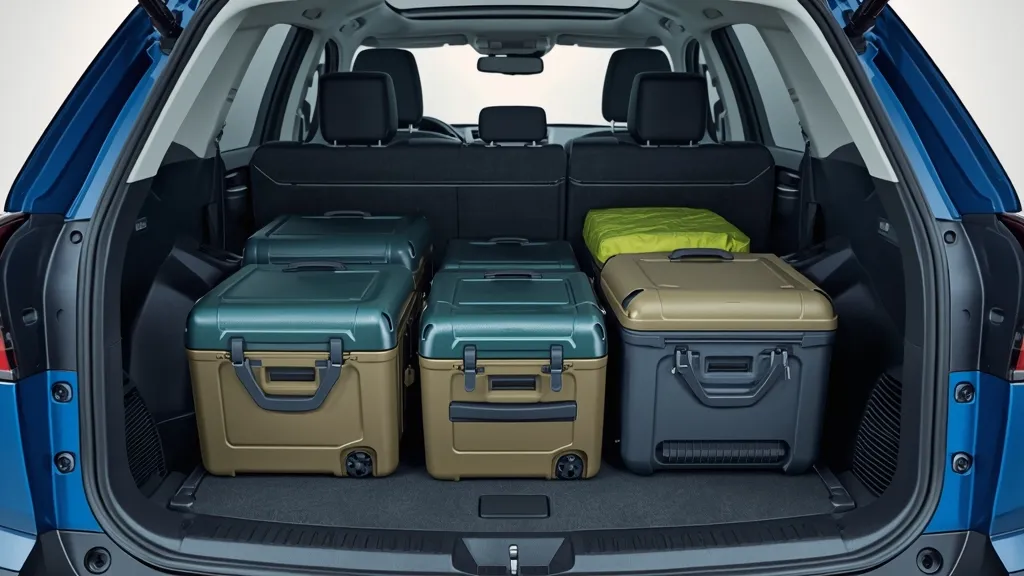
- Toyota RAV4: Offers 37.6 cubic feet of space behind the rear seats. The floor is low, and the opening is wide.
- Mazda CX-5: Offers 30.8 cubic feet. While it’s enough for a week’s worth of groceries, it’s noticeably smaller than the Toyota. If you have a large stroller or frequently haul bulky sports gear, the RAV4 is the better tool for the job.
Rear Passenger Space
The RAV4 offers more rear legroom and a flatter floor, making it easier to fit three people across the back seat. The CX-5 rear seat is comfortable, but the middle passenger has to contend with a larger “hump” in the floor for the drivetrain.
Reliability and Resale Value
When we talk about Toyota RAV4 vs CX-5 reliability, we are splitting hairs between two of the best in the business.
SUV Resale Value Comparison
Toyota generally holds its value better than almost any other brand on the market. If you plan to sell the car in 3 to 5 years, you will likely get a higher percentage of your money back with the RAV4. However, Mazda move toward the premium segment has helped its resale values climb significantly in recent years.
Long-Term Dependability
Toyota has the edge in long-term parts availability and a massive dealership network. Mazda, however, has consistently ranked near the top of reliability surveys by J.D. Power, 2023, often beating out even Lexus and Toyota in certain years.
Real-Life Case Study: The Miller Family Dilemma
To illustrate the Mazda CX-5 vs Toyota RAV4 choice, let’s look at a real-life scenario. The Millers are a family of four living in the suburbs. They enjoy weekend trips to the mountains but also have a 45-minute daily commute.
The Choice:
Mr. Miller loved the CX-5 vs RAV4 driving experience in the Mazda. He preferred the way the Turbo engine felt and the way the interior looked like a luxury car. However, Mrs. Miller was concerned about the CX-5 vs RAV4 fuel economy. With their long commute, the 41 MPG of the RAV4 Hybrid was impossible to ignore.
The Verdict:
They chose the Toyota RAV4 Hybrid. For them, the long-term savings on fuel and the extra cargo capacity small SUV for their kids’ soccer gear outweighed the sporty handling of the Mazda. However, their neighbor, a single professional who works from home, chose the Mazda CX-5 because they wanted a car that felt special every time they got behind the wheel for a weekend drive.
Pros and Cons Summary
Mazda CX-5
Pros:
- Interior looks and feels like a luxury vehicle.
- Best-in-class handling and steering.
- Beautiful exterior design.
- Very quiet at highway speeds.
Cons:
- Smaller cargo area.
- No hybrid powertrain available.
- Infotainment system has a learning curve.
Toyota RAV4
Pros:
- Incredible fuel economy (Hybrid/Prime).
- Massive cargo space and practical storage.
- Rugged, “go-anywhere” styling.
- Exceptional resale value.
Cons:
- Engine can be noisy when accelerating hard.
- Interior materials feel more “utility” than “luxury.”
- Handling is safe but uninspiring.
Conclusion: Which One is Right for You?
In the final tally of the Mazda CX-5 vs Toyota RAV4, there is no “wrong” answer. Both are at the top of their game.
If you want a vehicle that makes you feel like you’ve “made it,” with a cabin that rivals European luxury brands and a CX-5 vs RAV4 driving experience that puts a smile on your face, go with the Mazda CX-5. It is the soulful choice.
However, if you are looking for the ultimate tool—a vehicle that maximizes every drop of fuel, fits all your gear, and will likely last for 200,000 miles with basic maintenance—the Toyota RAV4 is the undisputed king. It is the best small SUV for families who value practicality and efficiency above all else.
Before you make your final decision, I highly recommend test-driving both on the same day. Drive the RAV4 first to see its utility, then jump into the CX-5 to feel the difference in refinement. Your gut will likely tell you which one fits your personality within the first five minutes.
Mazda CX-5 vs Toyota RAV4 FAQs
Question: Which SUV has better fuel economy: Mazda CX-5 or Toyota RAV4?
Answer: The Toyota RAV4, particularly its hybrid and Prime (PHEV) models, offers significantly better fuel economy than the Mazda CX-5. The RAV4 Hybrid achieves around 40 MPG combined, while the RAV4 Prime boasts 42 miles of electric range and 94 MPGe, making it the efficiency leader.
Question: Is the Mazda CX-5 or Toyota RAV4 better for families?
Answer: The Toyota RAV4 is generally more practical for families due to its superior cargo capacity and more spacious rear seating. While the Mazda CX-5 offers a premium feel, the RAV4 utility, robust safety features, and efficient hybrid options make it a highly adaptable choice for family needs.
Question: Which offers a more premium interior: Mazda CX-5 or Toyota RAV4?
Answer: The Mazda CX-5 consistently provides a more premium interior experience. It features higher-quality materials, sophisticated design, and meticulous craftsmanship that often rivals entry-level luxury brands, surpassing the more functional and utilitarian cabin of the Toyota RAV4 in aesthetic appeal.
Question: Which SUV drives better: Mazda CX-5 or Toyota RAV4?
Answer: The Mazda CX-5 offers a more engaging and sporty driving experience, praised for its precise steering, refined suspension, and “car-like SUV handling.” It’s more enjoyable on winding roads, whereas the Toyota RAV4 prioritizes a competent, comfortable ride and practicality over dynamic performance.
Question: What are the main differences in reliability between the Mazda CX-5 and Toyota RAV4?
Answer: Both the Mazda CX-5 and Toyota RAV4 are highly reliable vehicles. Toyota has a long-standing reputation for bulletproof dependability and strong resale value. Mazda has significantly improved its reliability ratings in recent years, often matching or even surpassing Toyota in certain independent surveys, making both excellent long-term choices.
Author Bio:
James “Auto-Expert” Sullivan is a veteran automotive journalist with over 15 years of experience testing and reviewing compact SUVs. Having driven every iteration of the CX-5 and RAV4 since their inception, James specializes in helping families find the perfect balance between performance and practicality. He has contributed to major automotive publications and holds a degree in Mechanical Engineering, providing him with a deep understanding of what happens under the hood.
Disclaimer:
This article is for informational purposes only. While every effort has been made to ensure the accuracy of the information provided, vehicle specifications, pricing, and features can change based on model year and region. Always consult with a local dealership and check the official manufacturer websites for the most up-to-date data. Fuel economy figures are based on EPA estimates and may vary based on driving habits.
You can refer to more:
- Official Mazda CX-5 Information : Provides the most current and authoritative information directly from the manufacturer on the CX-5 features, specifications, and pricing, essential for accurate comparisons.
- Explore the Toyota RAV4 Lineup : Offers comprehensive details on the RAV4 various trims, including hybrid and Prime models, official specifications, and available technologies directly from Toyota, crucial for understanding its full offering.
- IIHS Vehicle Safety Ratings : Direct source for independent crash test ratings and safety awards (Top Safety Pick+) for both the Mazda CX-5 and Toyota RAV4, helping readers assess their safety credentials.
- Consumer Reports Car Reliability & Owner Satisfaction : Provides unbiased, data-driven insights into vehicle reliability, owner satisfaction, and predicted longevity, highly relevant for Toyota RAV4 vs CX-5 reliability and SUV resale value comparison analysis.