
CATL’s first‑quarter net profit of $3.06 bn outpaced the combined earnings of seven major Chinese automakers, underscoring its dominance in the EV battery market. Discover the factors driving this surge.
China’s battery behemoth CATL reported a net profit of 20.7 billion yuan (about $3.06 billion) for the first quarter, a figure that dwarfs the combined earnings of seven of the country’s leading car manufacturers.
Record‑breaking Numbers
During the same period, CATL installed 59.52 GWh of batteries domestically, securing a 46.4% share of China’s EV‑battery market – a 3.47% increase year‑on‑year despite a slowdown in electric‑vehicle sales caused by the gradual removal of government subsidies.
The company’s total revenue reached 129.13 billion yuan ($17.9 billion), surpassing the entire 2025 annual revenue of Li Auto, Nio and Xpeng combined.
Outpacing the Auto Industry
The 20.7 billion‑yuan profit easily eclipses the first‑quarter net profit of seven top Chinese automakers – Chery, Geely, BYD, SAIC, Great Wall Motors, Seres and Changan – whose combined profit was roughly 17.5 billion yuan ($2.59 billion).
Looking ahead to full‑year 2025, CATL projects a net profit of 72.2 billion yuan ($10.68 billion), which would outstrip the total earnings of all 13 A‑share listed automobile manufacturers in China.
Strategic Partnerships and Infrastructure
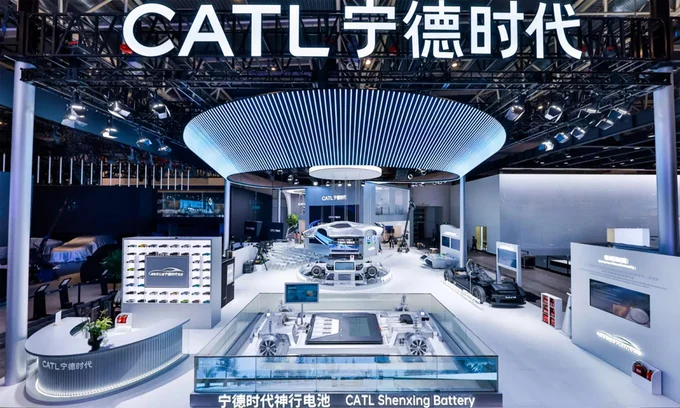
Several automakers, including Geely and SAIC, have entered joint ventures with CATL, reinforcing the battery maker’s role as a cornerstone of China’s automotive supply chain. CATL is also accelerating the rollout of battery‑swap stations across the country.
Beyond Cars: Energy Storage for AI Data Centers
Chinese EV‑battery producers are repurposing their massive manufacturing capacity toward large‑scale energy‑storage systems that will power AI‑driven data centers. CATL leads this shift, competing for high‑margin infrastructure contracts alongside regional rivals.
Solid‑State and Sodium‑Ion Developments
CATL’s chairman Robin Zeng recently warned that mass production of solid‑state batteries remains distant, but chemical‑based alternatives are already finding market traction. The company is rolling out 300 Ah sodium‑ion modules with a lifespan of up to 15,000 cycles, designed to fit standard lithium‑ion casings for seamless integration.
In parallel, BYD is constructing a “sodium‑ion fortress” to dominate the next‑generation storage landscape, while Japan’s Panasonic has earmarked 14.9 billion yuan ($2.2 billion) for dedicated storage assembly lines in North America. However, Panasonic faces stiff competition from local giants such as Envision Energy, Hithium and Sungrow.
Milestone Projects
By the end of 2025, CATL will have completed a 2 GW grid‑scale storage system in southwest China, and Vision Group will finish a pilot liquid‑immersion cooling project. These achievements highlight the rapid commercialization of utility‑scale storage solutions.
Future Demand Outlook
Global data‑center electricity consumption is expected to double by 2030 compared with 2025 baselines, creating a massive, sustained demand for high‑power storage infrastructure. This shift is moving the battery battleground from vehicle chassis to the power‑grid network, positioning Chinese cell makers for continued revenue growth.
Stay tuned for more updates on how CATL and its rivals are reshaping the future of energy storage and electric mobility.