
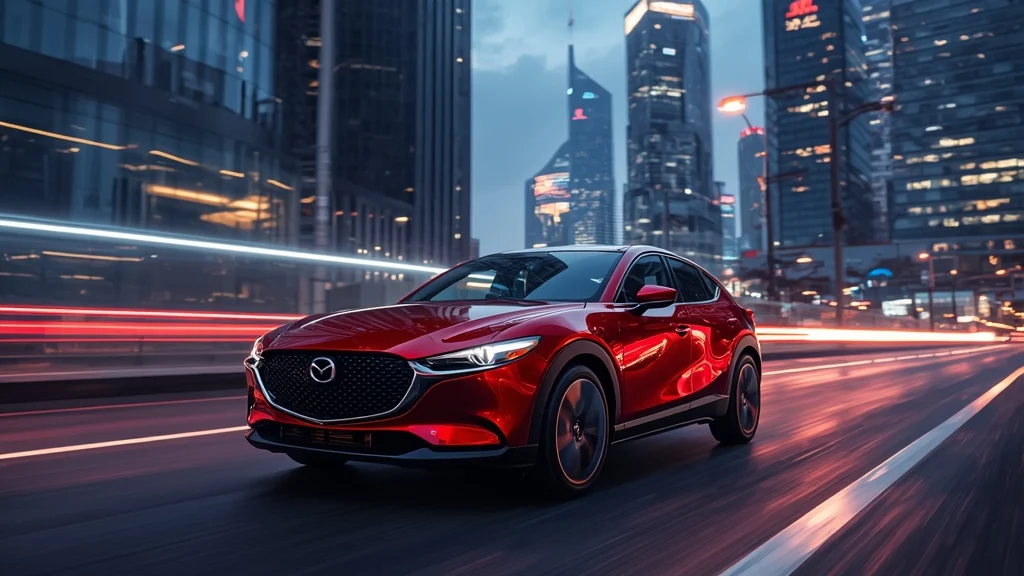
Can Mazda become the first joint venture to outsell ICE cars with EVs in China? Discover their strategic shift and Changan partnership. Read more!
For decades, Mazda has been celebrated as the purist’s choice, renowned for its mastery of the internal combustion engine (ICE) and its legendary rotary technology. However, in the rapidly evolving landscape of the Chinese automotive market, tradition alone is no longer enough. Mazda is now placing a massive bet on electrification to ensure its survival and growth.
A Historic Shift in Sales Dynamics
Speaking at the Beijing Auto Show 2026, Mazda CEO Toru Nakajima delivered a striking assertion: Mazda is on track to become the first foreign joint venture in China to sell more New Energy Vehicles (NEVs) than traditional internal combustion engine vehicles.
The numbers already tell a compelling story. In the first quarter of the year, NEVs accounted for a staggering 47% of Mazda’s total sales in China. This represents a pivotal moment for the brand as it attempts to align its identity with the digital-first, eco-conscious demands of the modern Chinese consumer.
Learning from Early Missteps
Mazda’s journey into electrification hasn’t been without its hurdles. The company entered the EV race relatively late, launching the MX-30 in 2019. Initial efforts in China were largely dismissed as “compliance-led” rather than market-driven.
A prime example was the CX-30 EV, a battery-electric version of the popular crossover. The model failed to resonate with local buyers, resulting in a dismal total of only about 500 units delivered between 2022 and 2024. It became clear that simply converting an ICE chassis into an EV was not the winning formula.
The Changan Partnership: A Game Changer
To pivot effectively, Mazda leaned heavily into its 20-year partnership with Changan. By utilizing Changan’s advanced EPA architecture, Mazda has developed a new wave of competitive models:
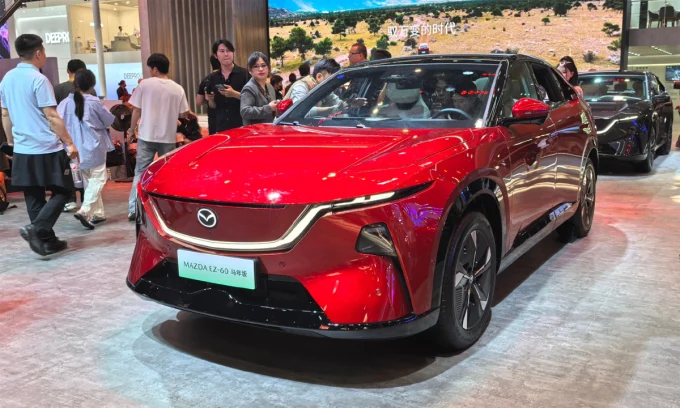
- The 6e (marketed as the EZ-6): A sleek sedan targeting the tech-savvy urban demographic.
- The CX-6e (marketed as the EZ-60): A mid-sized SUV designed for versatility and power.
Crucially, both models are offered with dual powertrain options: fully electric (BEV) and Extended Range Electric Vehicle (EREV) systems, providing the flexibility that many Chinese buyers still crave to eliminate range anxiety.
Exceeding Expectations
The strategic shift is paying off. According to China EV DataTracker, Mazda delivered a total of 91,061 vehicles between April 2025 and March 2026. This performance exceeded the company’s own optimistic forecast of 76,000 units by nearly 20%.
The success is largely driven by the EZ-6 and EZ-60, which together accounted for over 40% of Mazda’s monthly sales in Q1. While some critics argue that the percentage growth is inflated because Mazda’s overall market share remains relatively small—with 21,619 deliveries in Q1—the trend is undeniable.
The Broader Competitive Landscape
Mazda’s agility stands in stark contrast to other Japanese joint ventures. Many of its peers still rely heavily on aging ICE platforms. For instance, Dongfeng-Nissan continues to see massive success with the Nissan Sylphy, a model introduced in 2012 that remains a top-seller despite lacking modern tech features.
While other giants like FAW-Toyota (with the bZ5) and Dongfeng-Nissan (with the NX8) are introducing NEVs, Mazda’s aggressive pivot suggests a more urgent realization: the window for ICE dominance is closing.
The Road Ahead: The Battle for AI and UX
Despite the current momentum, the climb remains steep. Mazda is not just competing with other legacy brands, but with domestic Chinese powerhouses. These local brands currently hold a significant lead in integrated AI, smart cockpit features, and high-end infotainment systems.
For Mazda, the challenge will be maintaining its “Zoom-Zoom” driving soul while integrating the futuristic technology that Chinese consumers now demand as standard. If they succeed, Mazda won’t just survive the electric transition—they will lead it.