
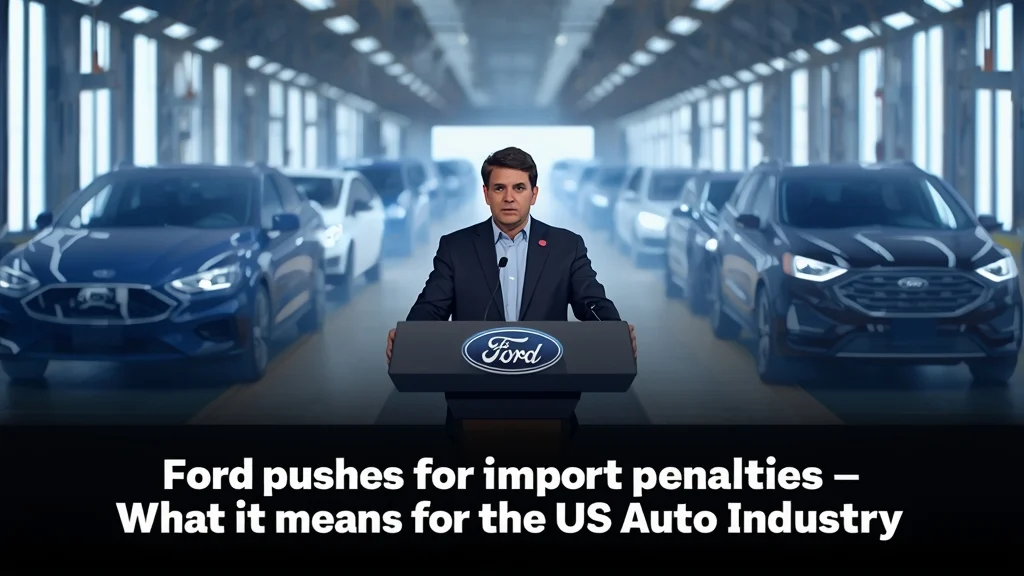
Ford’s CEO Jim Farley urges tougher trade rules to penalize import‑dependent car makers like GM and Toyota as USMCA negotiations resume. Learn more now.
During the latest round of USMCA (United States‑Mexico‑Canada Agreement) talks, Ford chief executive Jim Farley warned that the United States needs a level playing field for automakers that produce the majority of their vehicles domestically.
Why Ford is pushing for stricter rules
Farley told CNBC that companies like Ford, which assembled more than 2 million cars in the United States in 2025, should be rewarded for their local investment. In contrast, rivals that depend heavily on imported vehicles – notably General Motors (GM) and Toyota – should face “penalties or trade barriers” that reflect their reliance on foreign‑built stock.
Import statistics that sparked the debate
- General Motors imported 1.17 million vehicles in 2025, accounting for roughly 41 % of all cars sold in the U.S.
- Toyota shipped more than 1.19 million imported units, representing about 47 % of its U.S. sales.
- Hyundai is on track to double its U.S. production share to 80 % by 2030, yet it remains the largest Korean importer after GM.
- Ford imported only 378,000 vehicles – just 17 % of its 2.2 million total sales – and exported 311,000 cars to over 60 markets worldwide.
The broader trade context
The push for a more protectionist stance comes after former President Donald Trump chose not to renew the three‑nation USMCA treaty. Instead, the United States will now review the agreement each year, with a possible full termination as early as 2036.

Automotive trade represents roughly 18 % of the United States’ total commerce with its North‑American neighbors. Industry leaders and trade observers warn that any drastic changes to USMCA could destabilise investment flows, jeopardise jobs, and trigger a wave of retaliation from Japan, South Korea and other global logistics hubs.
What Ford hopes to achieve
Farley’s core demand is simple: the next trade deal must give U.S. manufacturers a competitive edge, not a heavier burden. He argues that domestic production lowers labor costs and supports American jobs, while heavy reliance on Asian‑manufactured cars gives foreign competitors an unfair advantage.
“The new agreement should help American builders compete more easily, not make it harder for them in the face of imported vehicles from Japan, Korea, or any other global logistics hub,” Farley emphasized.
Industry reactions
Other automakers have mixed responses. While some welcome a clearer rule‑book, others fear that punitive measures could raise vehicle prices for consumers and limit model variety. The debate is poised to shape the future of the U.S. auto market for the next decade.
As USMCA negotiations continue, all eyes remain on Washington to see whether Farley’s call for penalties will translate into concrete policy changes.