
Discover how Ford can dominate recall numbers while achieving the highest initial quality score among mass-market cars – read the full analysis now!
According to data compiled by Carscoops, Ford logged a total of 153 recall events last year, keeping the automaker at the top of the U.S. recall leaderboard. As of mid‑2026, the number of open recalls has dropped to 51, still well ahead of rivals such as Stellantis (19), General Motors (17) and Toyota (15).
Ford Leads the Mass‑Market Segment in JD Power’s Initial Quality Study
Despite the recall headline, Ford received the highest score among mainstream brands in JD Power’s Initial Quality Study (IQS), which measures the number of problems reported per 100 vehicles (PP100) during the first 90 days of ownership. A lower PP100 means fewer issues.
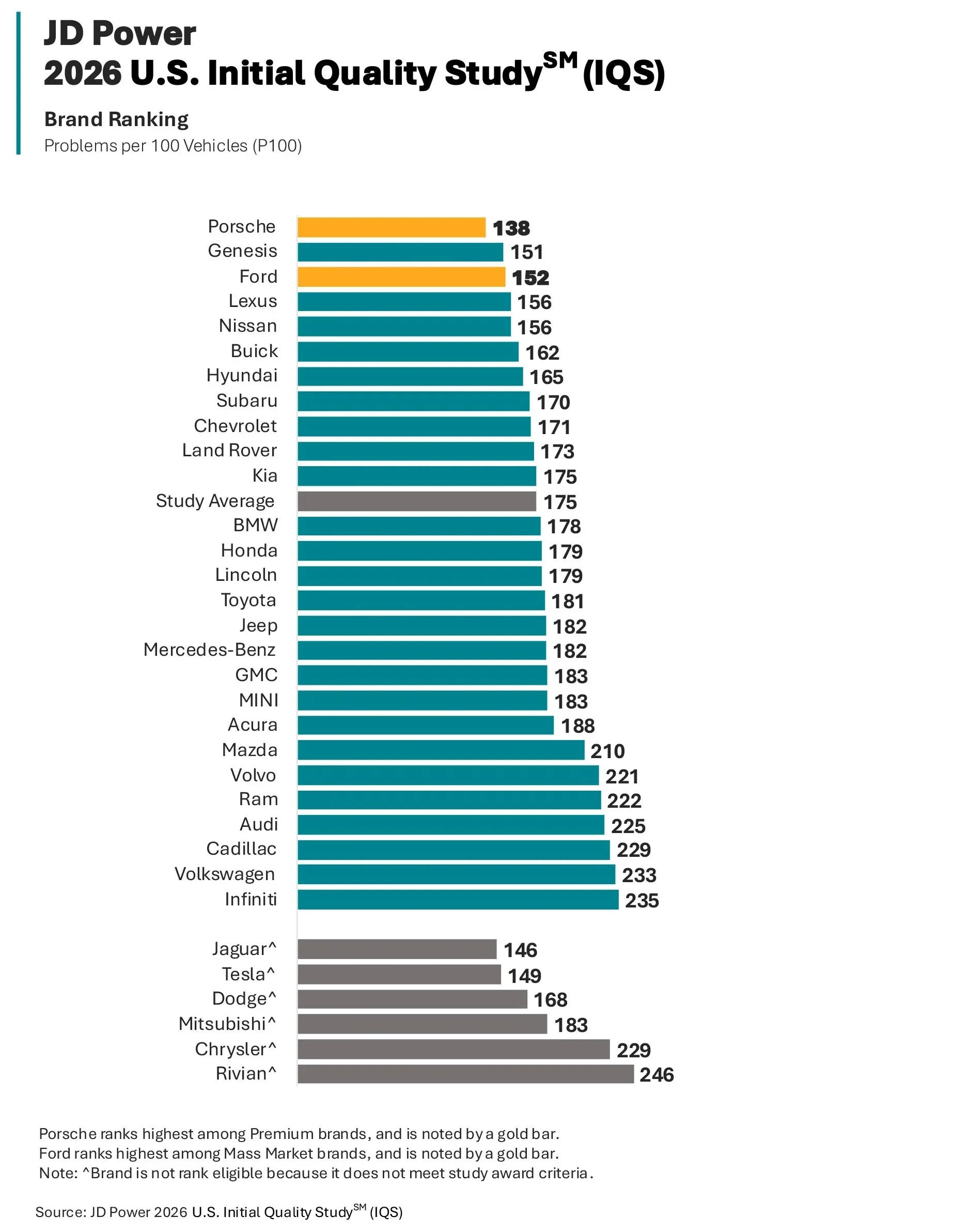
- Ford – 152 PP100 (rank 1 among mass‑market brands)
- Nissan – 156 PP100 (rank 2)
- Buick – 162 PP100 (rank 3)
Key models such as the Mustang, F‑150 and F‑Series Super Duty topped the PP100 rankings in their respective segments, pushing the brand’s overall score down 41 points compared with the previous year.
Luxury Segment Moves Up
Lincoln, Ford’s premium division, climbed two places to finish sixth among luxury marques. Overall, Ford placed third across all brands, behind Porsche (138 PP100) and Hyundai’s Genesis (151 PP100), the latter making a remarkable jump from tenth place last year.
How Other Brands Fared
- Porsche – 138 PP100 (overall leader; 911 recorded the fewest problems)
- Genesis – 151 PP100 (second place, a major improvement)
- Lexus – fell from first to fourth
- Land Rover – rose to the upper half of the table with 173 PP100 (down from 208)
- Audi – improved to 225 PP100 but moved only three spots
- Infiniti – finished last with 235 PP100, down from 242
Segment Highlights
Low‑rider sedans led by the Kia K4, Hyundai Sonata and Cadillac CT4 posted the best PP100 scores, followed closely by BMW models. In the crossover/SUV arena, the Nissan Rogue, Chevrolet Blazer, Hyundai Venue and Subaru Ascent were the most trouble‑free, while the Chevrolet Tahoe and Toyota Sequoia led the large‑SUV class.
Among premium vehicles, the Cadillac XT5, Lexus NX and BMW X2, X6 and X7 recorded the strongest initial quality numbers. The Kia Carnival was named the best MPV, and the Hyundai Santa Cruz topped the mid‑size pickup category.
What the Study Measures
JD Power’s IQS tracks issues reported by owners in the first 90 days of ownership. The overall average PP100 for U.S. new‑car owners fell from 192 last year to 175 this year, indicating a notable improvement in early‑life quality across the market.
Where the Scores May Be Misleading
Not every data point reflects true vehicle reliability. For example, cup‑holder design contributed heavily to the overall score improvement because newer models offer more accessible and versatile storage. Conversely, infotainment systems were the biggest source of negative feedback, with connectivity glitches in Android Auto and Apple CarPlay adding 1.4 PP100 points to the average.
Despite these nuances, Ford’s ability to cut its PP100 by 41 points while still handling the most recalls demonstrates a strong commitment to fixing problems quickly and delivering a more reliable driving experience.
As the industry continues to tighten quality controls, consumers can expect even better initial ownership experiences from the brands that learn from their recall data.